
Having ideas is the easy part. Knowing if your audience actually cares is where the headache starts.
Traditional focus groups are still one of the most useful ways to uncover that layer. They help brands hear how people frame a problem in their own words, how they react to other opinions, where they agree and where tension appears.
But they’re also kind of a pain to pull off:
- Recruiting the right participants takes time.
- Moderation requires real expertise.
- Analysis often depends on hours of notes, recordings, and interpretation.
For many marketing teams, that means qualitative research is used only at major decision points, not as part of everyday strategy.
At Chatoptic, we wanted to make that kind of audience thinking more accessible.
That is why we built AI Focus Groups.
What Are Chatoptic AI Focus Groups?
While Chatoptic already allowed you to build and chat with individual AI personas in a 1-on-1 setting, AI Focus Groups take things a step further by bringing those personas together into simulated group discussions.
Each persona is built around demographic, psychological, behavioral, and contextual traits. Instead of asking one generic AI model what “the audience” thinks, you can create a group of different audience types and see how they respond to a shared topic.
The discussion is moderated through structured rounds, allowing the personas to respond, challenge each other, refine their opinions, and expose points of agreement or disagreement.
The goal is not to claim that AI personas are real people, they are not.
The goal is to create a structured research environment that helps marketers explore likely audience reactions, language patterns, objections, motivations, and decision drivers at a much faster pace than traditional qualitative research.
The Framework Behind our AI Focus Groups
Our AI Focus Groups are NOT designed as a free-form conversation between AI agents.
The feature was built around established focus group principles, heavily influenced by Richard Krueger’s framework.
Our methodologies define several core pillars:
- Purposive Persona Selection: We use purposive sampling to select specific personas that mirror your target audience segments, ensuring relevant and focused feedback.
- Structured Introduction: Every session follows a standard routine to set a thoughtful tone, define the research scope, and establish ground rules.
- Logical Questioning Route: Discussions move systematically from general opening topics to specific key questions to uncover deeper qualitative insights.
- Group Dynamics: Personas are designed to talk to each other, building on ideas and reacting to comments, to generate shared meanings just like a real group.
- Thematic Reporting: Our analysis identifies recurring themes and emotional intensity by looking at the specific words and context used in the discussion.
This structure helps your team develop better innitial hypotheses and test assumptions much faster than traditional methods.
Please note: Chatoptic AI Focus Groups should not be treated as a replacement for human research. Instead, it gives marketing teams a fast, structured way to apply research discipline earlier in the process: simulating audience discussions, testing assumptions, uncovering qualitative patterns, and developing sharper hypotheses before investing in larger research, messaging and content creation as part of Generative Engine Optimization (GEO) process.
How It Works: A Simulated Netflix Example
To demonstrate the new feature, we created a fictional example using Netflix.
This is not based on a real Netflix project or internal Netflix data. It is only a simulated use case designed to show how the feature works.
Let’s imagine Netflix wanted to better understand how different Israeli audience segments perceive its value, content selection, recommendation experience, and potential pricing options.
Step 1: Define the Focus Group Topic
The first step is to define the focus group topic and business context.
For this example, the research goal was:
We are exploring the Israeli streaming market to understand how different demographics perceive Netflix’s value proposition. The discussion should focus on content gaps (local vs. international), willingness to adopt ad-supported tiers, and the ‘discovery’ process, how users ‘test’ and decide on a new series. We want to identify specific cultural pain points in the Israeli user experience, such as translation quality, the relevance of Israeli-original content, and family sharing habits across generations.
This gives the simulation a clear purpose. The discussion is not “what do people think about Netflix?”, It is tied to specific strategic questions that a brand might actually care about.
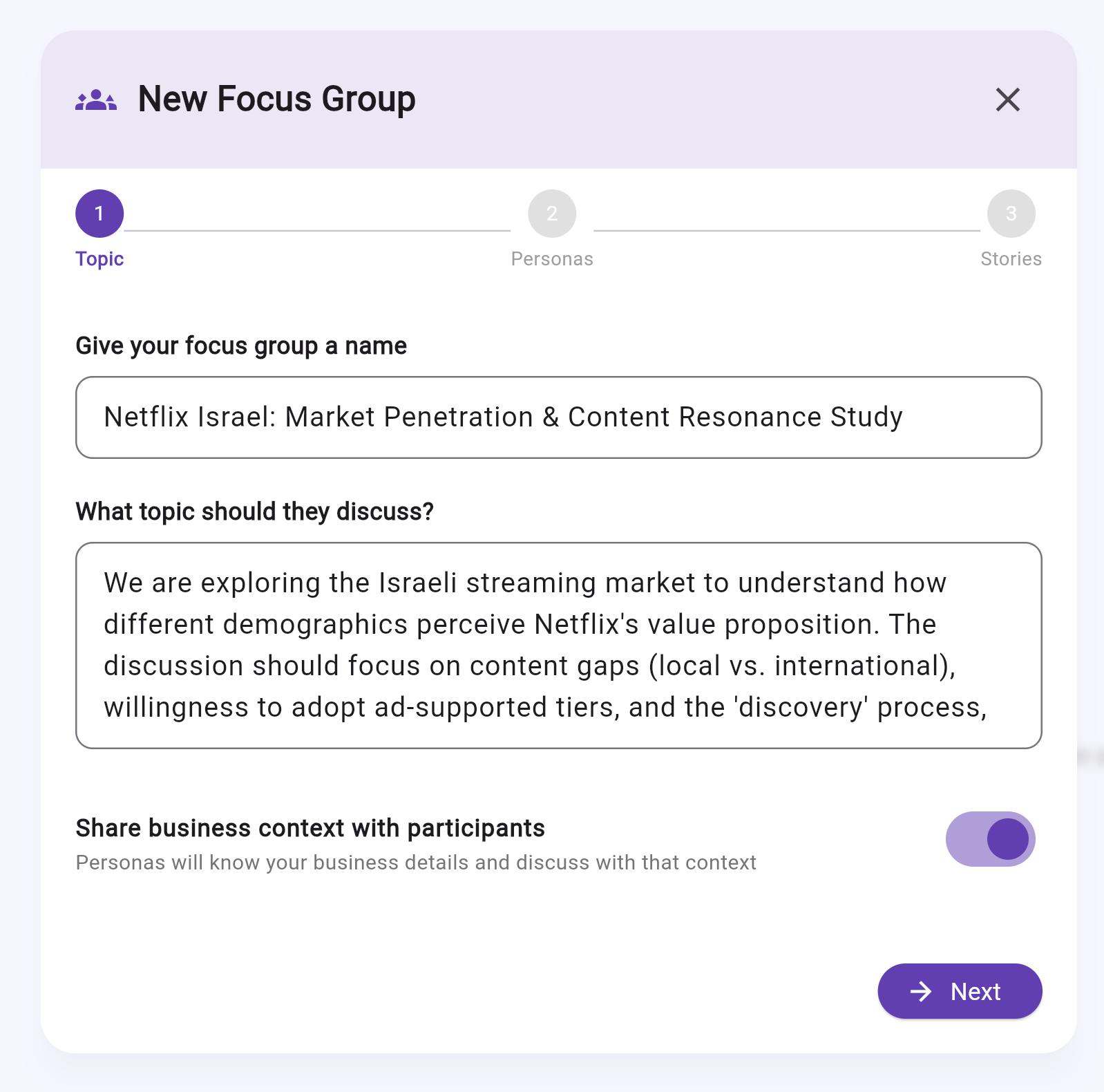
Should I enable the “Share business context with participants” toggle?
- Enable this toggle when your research goal requires targeted feedback on specific business objectives, aligning with research protocols that recommend providing participants with an overview of the topic and how the results will be used.
- Leave it disabled for ‘blind’ testing to capture raw, uninfluenced persona reactions, which is essential for avoiding bias and preventing the group’s thinking from being prejudiced before the discussion begins.
Step 2: Defining and Selecting the Participants
A professional focus group starts with a well defined audience.
In Chatoptic, you first build your library of target segments, creating detailed AI personas that represent your actual customers. These personas are the core foundation of our entire AI visibility tool, it’s what sets us apart from the competition, and it powers every single feature we build, including this one.
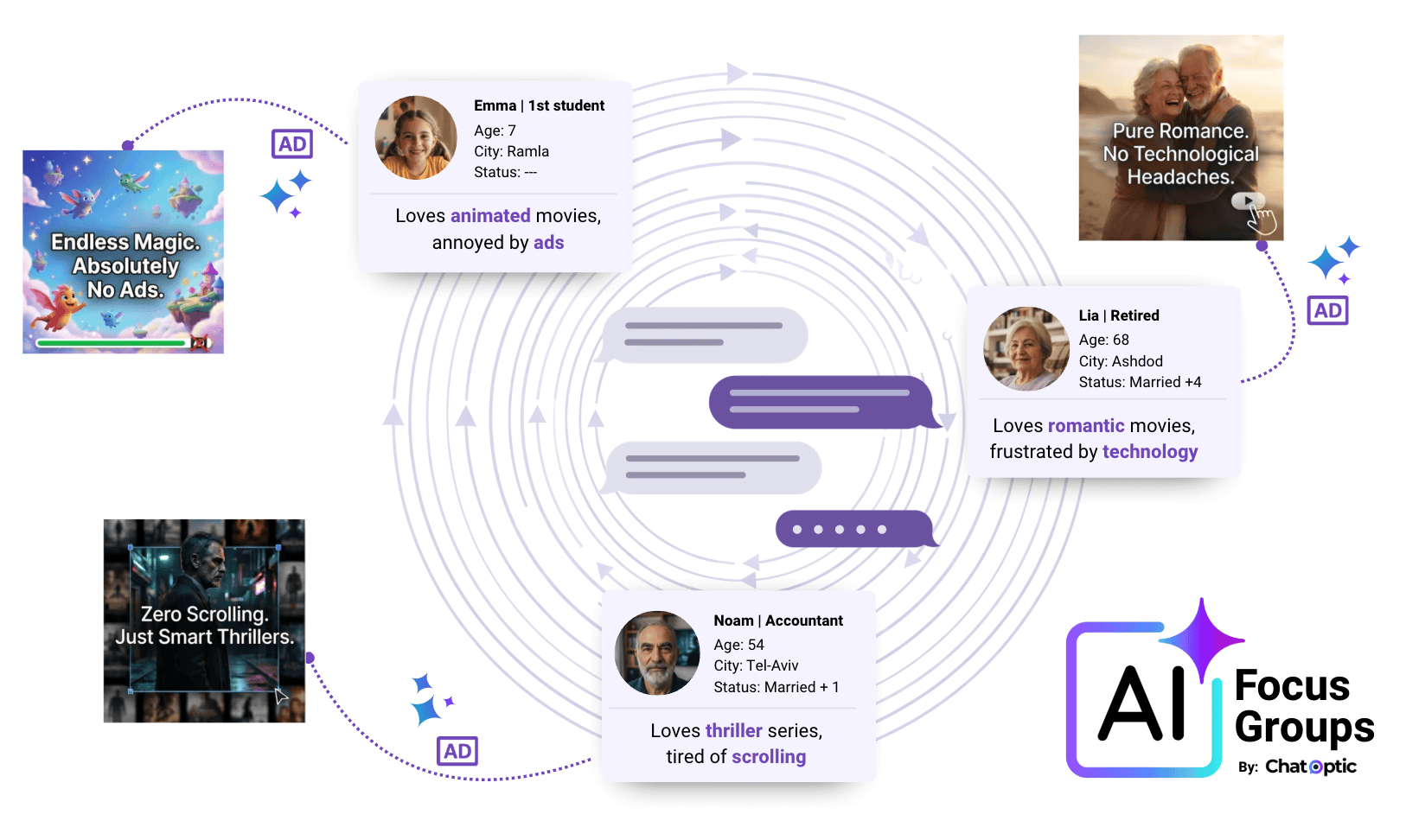
For the Netflix simulation, we built 4 distinct Israeli personas, each with a unique background, interest, and digital behavior:
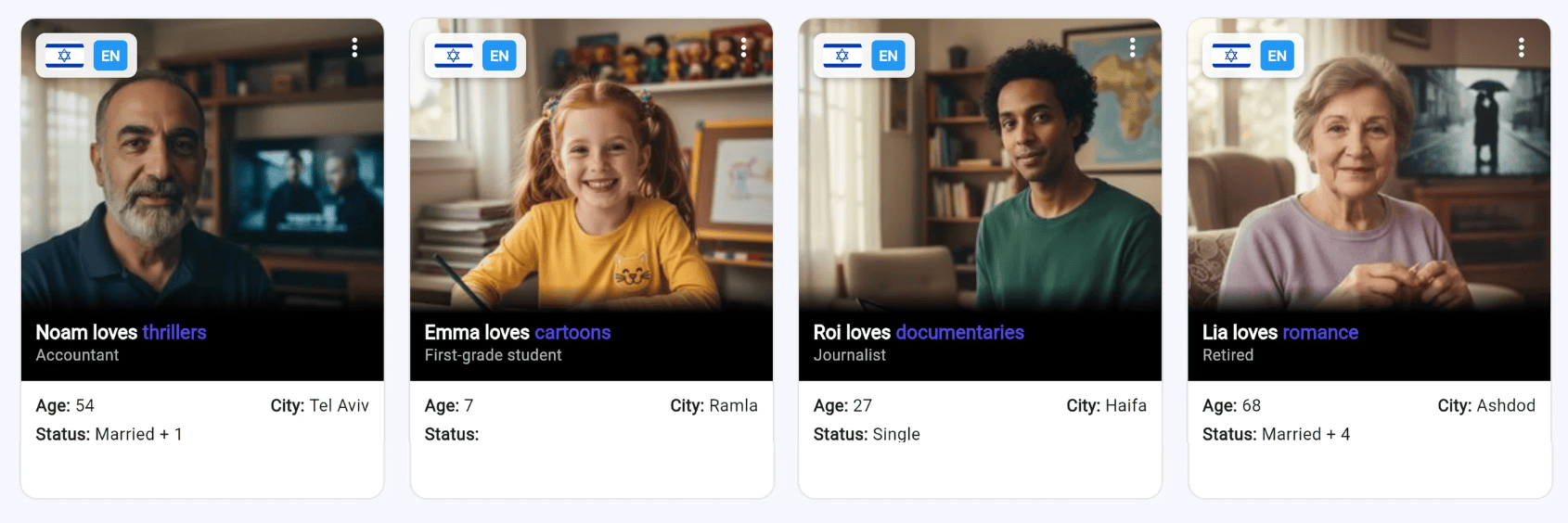
- Noam: A 54-year-old accountant who values “intellectually gripping” thrillers and has low patience for poor recommendations.
- Emma: A 7-year-old first class student looking for magical and funny cartoons she can discover independently.
- Roi: A 27-year-old journalist seeking authentic, culturally relevant investigative documentaries.
- Lia: A 68-year-old retiree who loves nostalgic romance but faces practical barriers with new technology.
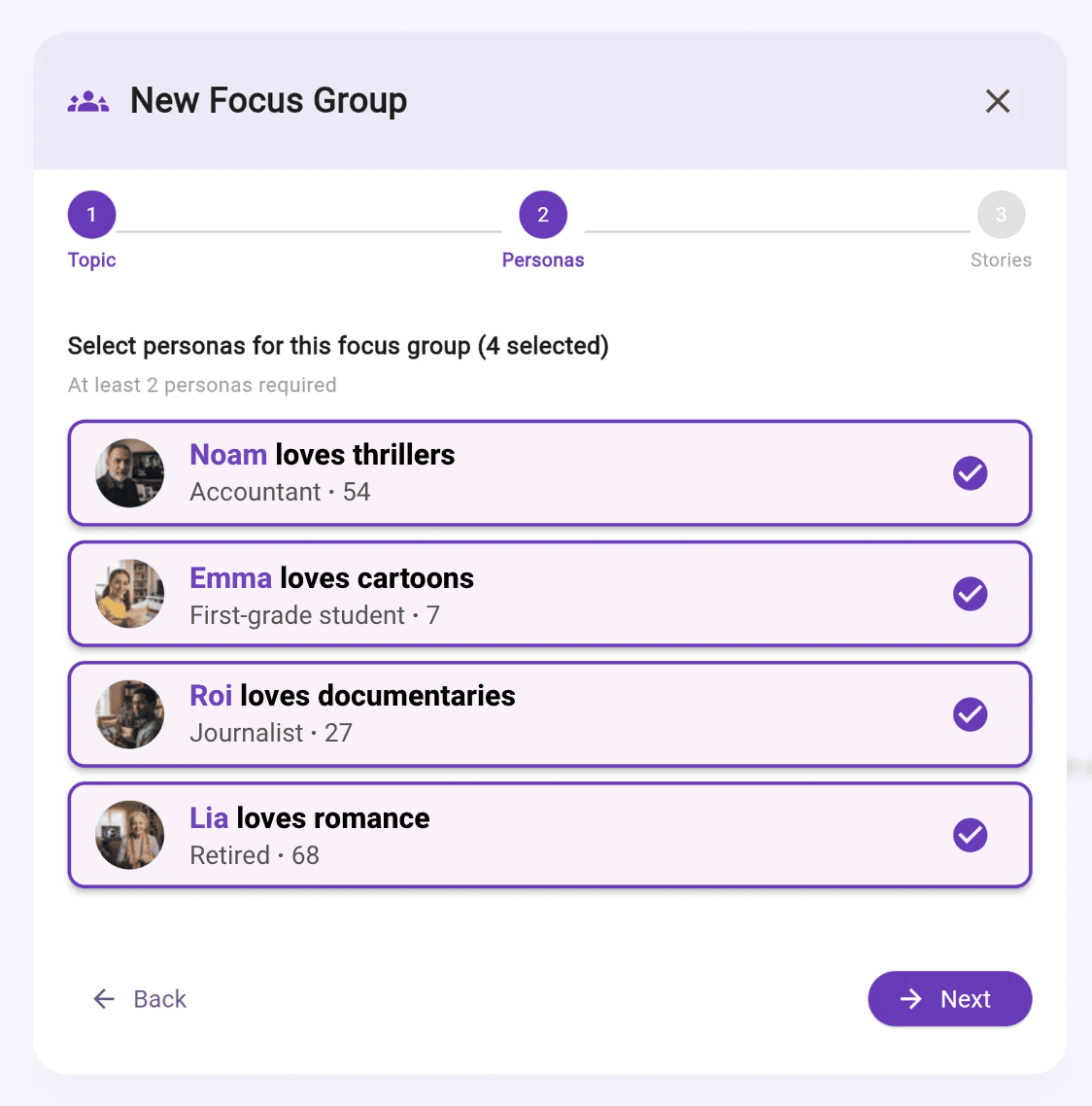
Once your library is ready, the next step is selecting the right mix for your specific study.
Within the New Focus Group interface, you simply pick the personas that are most relevant to the topic you want to explore.
Step 3: Adding Persona Context
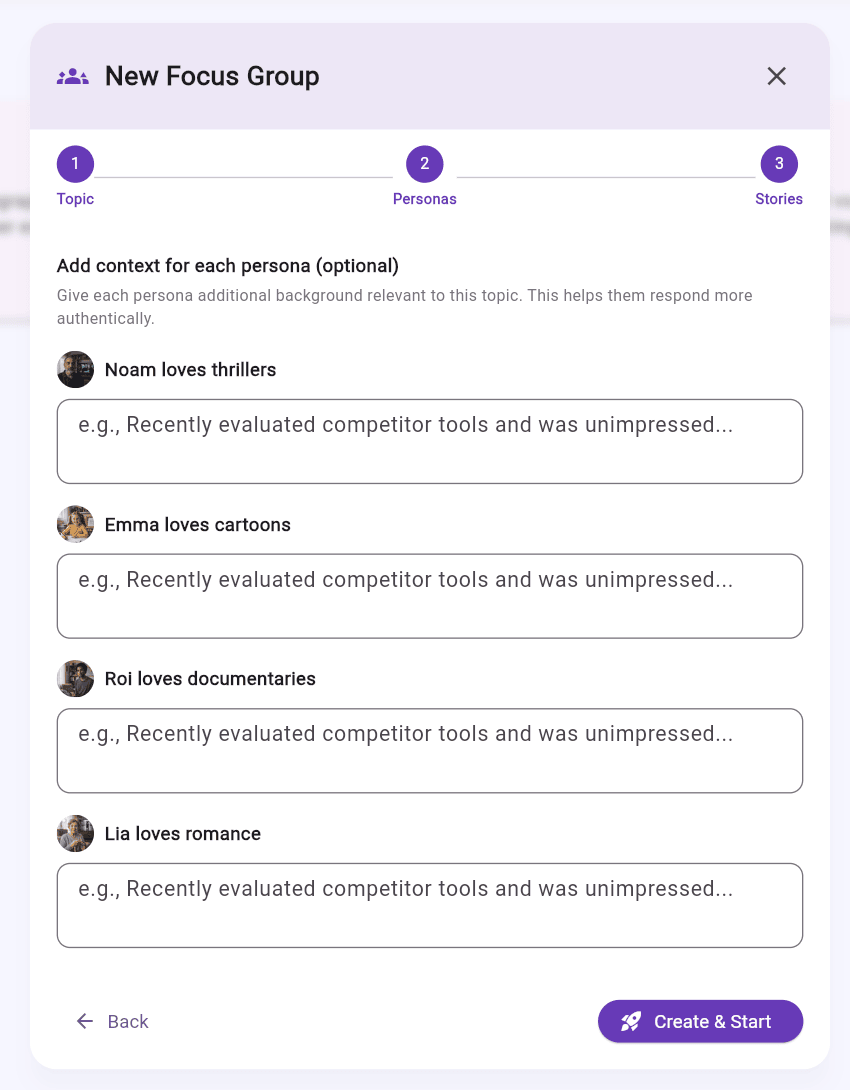
To make the simulation feel like a real-world conversation, Chatoptic allows you to give each persona a specific “story” or motivation directly related to your topic.
This ensures they don’t just speak in generic terms, but react based on real-life scenarios.
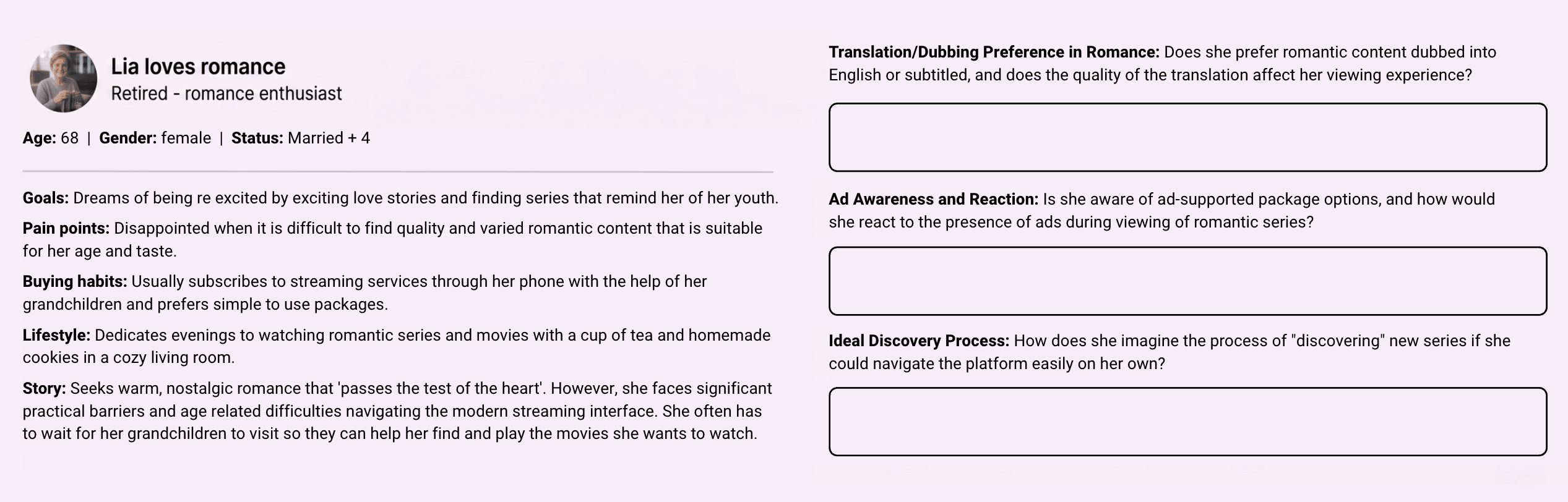
For our Netflix study, we added a specific layer of context for Lia:
“Lia seeks warm, nostalgic romance that ‘passes the test of the heart’. However, she faces significant practical barriers and age-related difficulties navigating the modern streaming interface. She often has to wait for her grandchildren to visit so they can help her find and play the movies she wants to watch.”
This brief background primes her persona, setting up her unique mindset and frustrations before the discussion even begins.
Step 4: The AI “Gap-Fill” Stage
Before the focus group simulation begins, the system automatically cross-references your selected research topic with the background profiles of your chosen personas.
If a persona’s core profile lacks specific data necessary to answer your research question accurately, the system flags these missing “information gaps” and prompts you to fill them in.
For our Netflix study, the system identified that while Lia’s general profile was complete, it lacked specific details regarding her streaming preferences and generated three precise questions:
- Translation/Dubbing Preference: We specified that Lia strongly prefers Hebrew subtitles over dubbing to preserve emotional authenticity, but notes that poor or tiny subtitles easily disrupt her viewing experience.
- Ad Awareness and Reaction: We clarified that she has low awareness of subscription tiers and would react negatively to ads breaking the quiet, warm atmosphere of her evenings.
- Ideal Discovery Process: We described her ideal setup—a simplified, highly visual interface or a voice-activated feature to easily find “something warm and nostalgic” without waiting for family help.
Providing these missing details ensures that the personas do not speak in broad hypotheticals, giving the simulation the exact decision logic needed to produce reliable qualitative data.
Step 5: Running the Discussion Rounds
Once everything is set up, the simulation starts. The personas don’t just answer standard questions one by one, they actually talk to each other.
This is exactly how real focus groups work, because the best insights usually come when people start reacting to what someone else just said.
In our Netflix Israel test, the first round immediately brought up three major complaints that almost everyone agreed on:
- Finding something to watch is a headache: Every single persona felt that searching for a show is an exhausting chore. Noam (the accountant) complained about wasting 40 minutes just scrolling after a long day at work. Roi (the journalist) felt the algorithm gives him shallow options instead of deep documentaries, while Lia (the retiree) explained she is completely stuck and has to wait for her grandkids to find a movie for her. Even 7-year-old Emma was annoyed when she ran out of cartoon seasons to talk about with her friends at school.
- Everyone hates ads: There was a total consensus here, nobody wants a cheaper subscription if it means watching commercials. Noam and Roi said ads ruin their focus during serious thrillers or documentaries, Lia felt it just makes the technology more complicated to use, and Emma simply said ads “ruin the fun.”
- Bad translation breaks the experience: Good Hebrew subtitles turned out to be a dealbreaker, but for very different reasons. For Lia, it’s emotional, she needs to understand every word to truly enjoy a romance. For Roi, if the translation is bad, it ruins the accuracy and deep meaning of a serious investigative story.
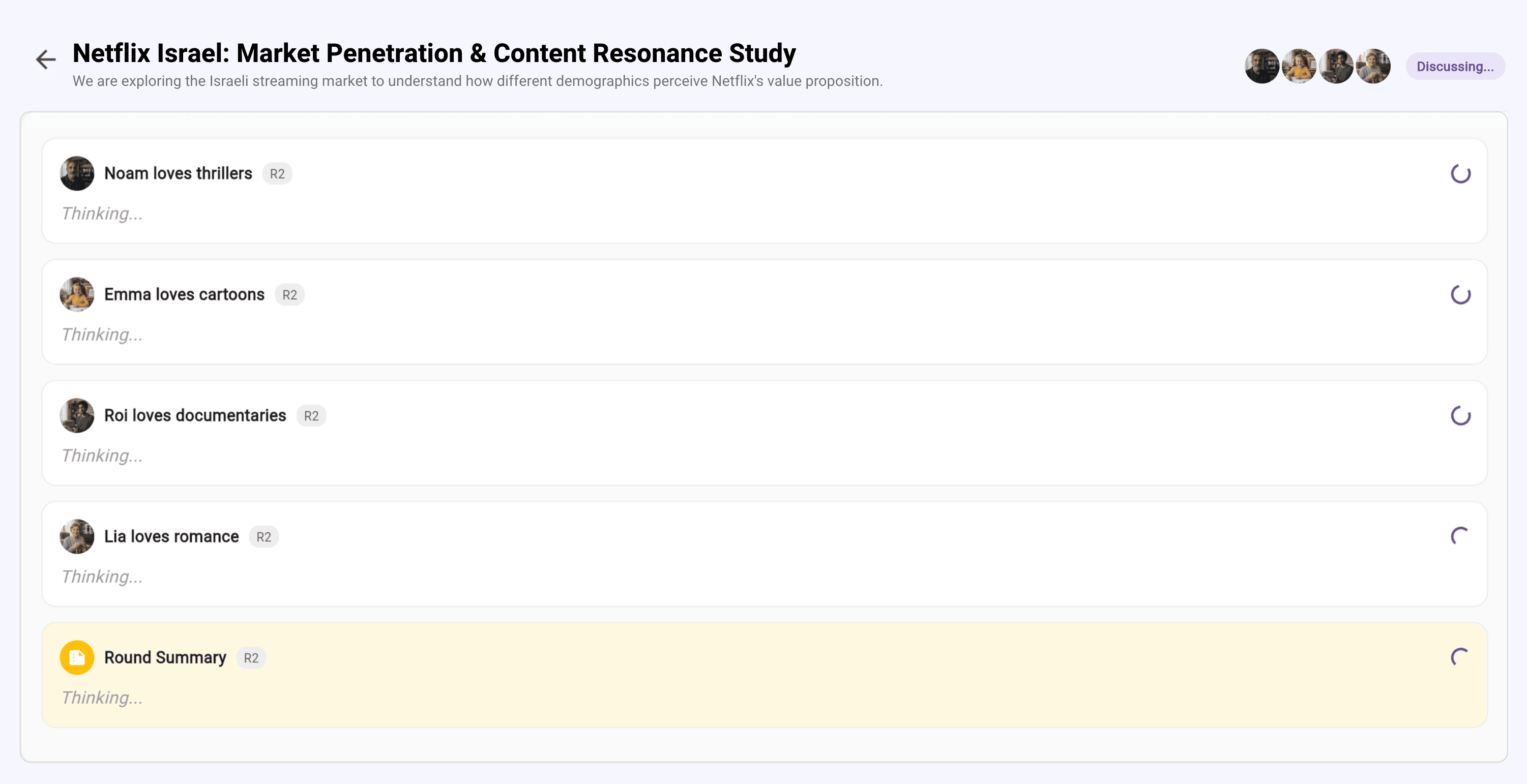
In the second round, nobody flipped their position, but their arguments became much more intense and specific. The automated summary highlighted exactly where the platform is missing the mark:
- The “Smart” Algorithm Feels Dumb: The frustration with finding content got worse. Noam and Roi both pointed out a new issue: the catalog feels like it “ends quickly” because the app keeps recommending the same average shows over and over. But the biggest eye-opener was Lia. While Noam complained about scrolling for 40 minutes, Lia reminded everyone that she can’t even start scrolling on her own, she is completely locked out of the app until her grandkids come over to set it up.
- Ads Aren’t a Financial Issue, They’re an Insult: The rejection of a cheaper, ad-supported tier became unanimous and emotional. The personas explained that they pay a premium specifically for peace and quiet. Noam and Roi felt commercials treat the viewer with disrespect during a deep story, and 7-year-old Emma hit the nail on the head by saying ads simply “break the dream” of the cartoon.
- Translation is the Remote Control of the Local Market: We discovered that Hebrew subtitles aren’t just a nice technical feature, they control how people experience the story. Emma needs good subtitles so her mom doesn’t have to sit next to her and translate the screen, Lia needs them to capture the “heart” of a romance and Roi needs them because a sloppy translation completely ruins the facts in an investigative documentary.
Why running several rounds? In a real research project, you rarely stop after one round. You want to push the group to see if their opinions hold up or if new details emerge. In Chatoptic, you can run another round with a single click to drill down into the core issues.
The Final Output: Thematic Analysis
When you click “Finish & Summarize”, Chatoptic processes the entire debate and builds a clean Thematic Analysis Report. Think of it as having a senior research assistant who takes the chaos of a group discussion and organizes it into clear, boardroom-ready notes.
The report breaks down everything into simple, actionable sections:
- Executive Summary: A short overview of the strongest findings and what they may mean for the brand.
- Key Themes: Recurring patterns that appeared across multiple personas, such as discovery frustration, price sensitivity, content gaps, trust, convenience, or emotional value.
- Persona-Level Insights: A breakdown of how each persona reacted, what motivated them, what bothered them, and what language they used.
- Conflict and Nuance: Areas where the group disagreed or where the same issue meant different things to different personas.
- Strategic Implications: Possible actions for messaging, content, product positioning, GEO strategy, or further research.
You can always access your report under the Focus Group section in your dashboard:
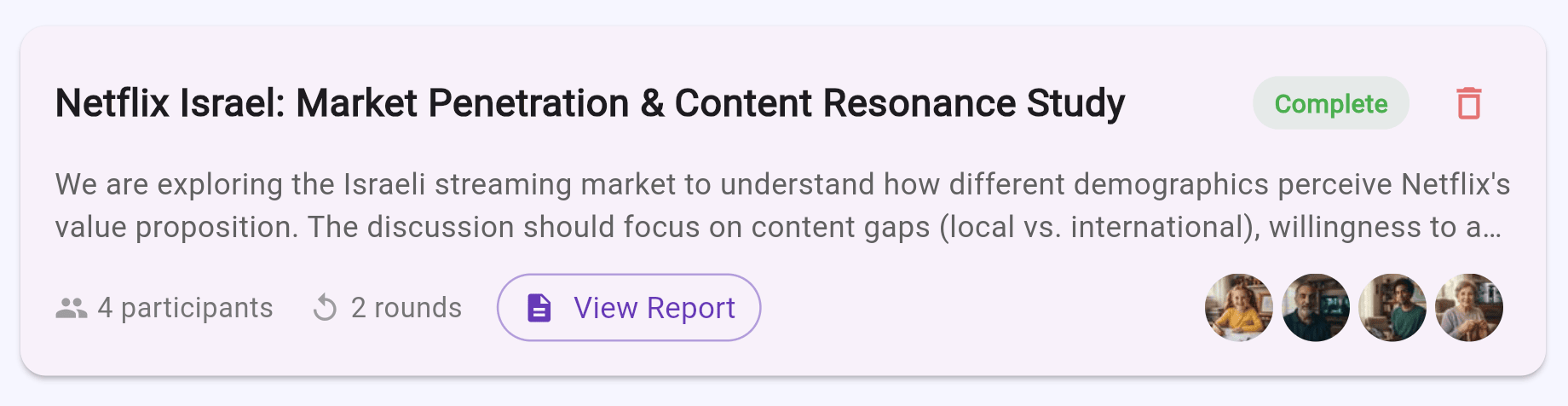
This final layer is important because the value of a focus group is not only in the conversation itself, but turning that conversation into decisions.
Closing the Loop: Transform Insights Into High-Converting Content
A great research report is only useful if you actually do something with it. With Chatoptic, your final Focus Group report doesn’t just sit in a folder, it instantly becomes a master creative brief for your entire marketing stack.
Instead of spending weeks guessing how to apply your findings, you can use this single session to hit three critical growth channels at once:
1. Hyper-Targeted Paid Ads
Imagine taking the exact pain points from your report to build hyper-targeted campaigns on Meta or Google. Instead of scratching your head trying to come up with creative angles, you can literally copy-paste your focus group summary as a brief into an AI image generator like Nano Banana 2.
In seconds, it will generate visual ad mockups that use the exact language and imagery your audience connects with.
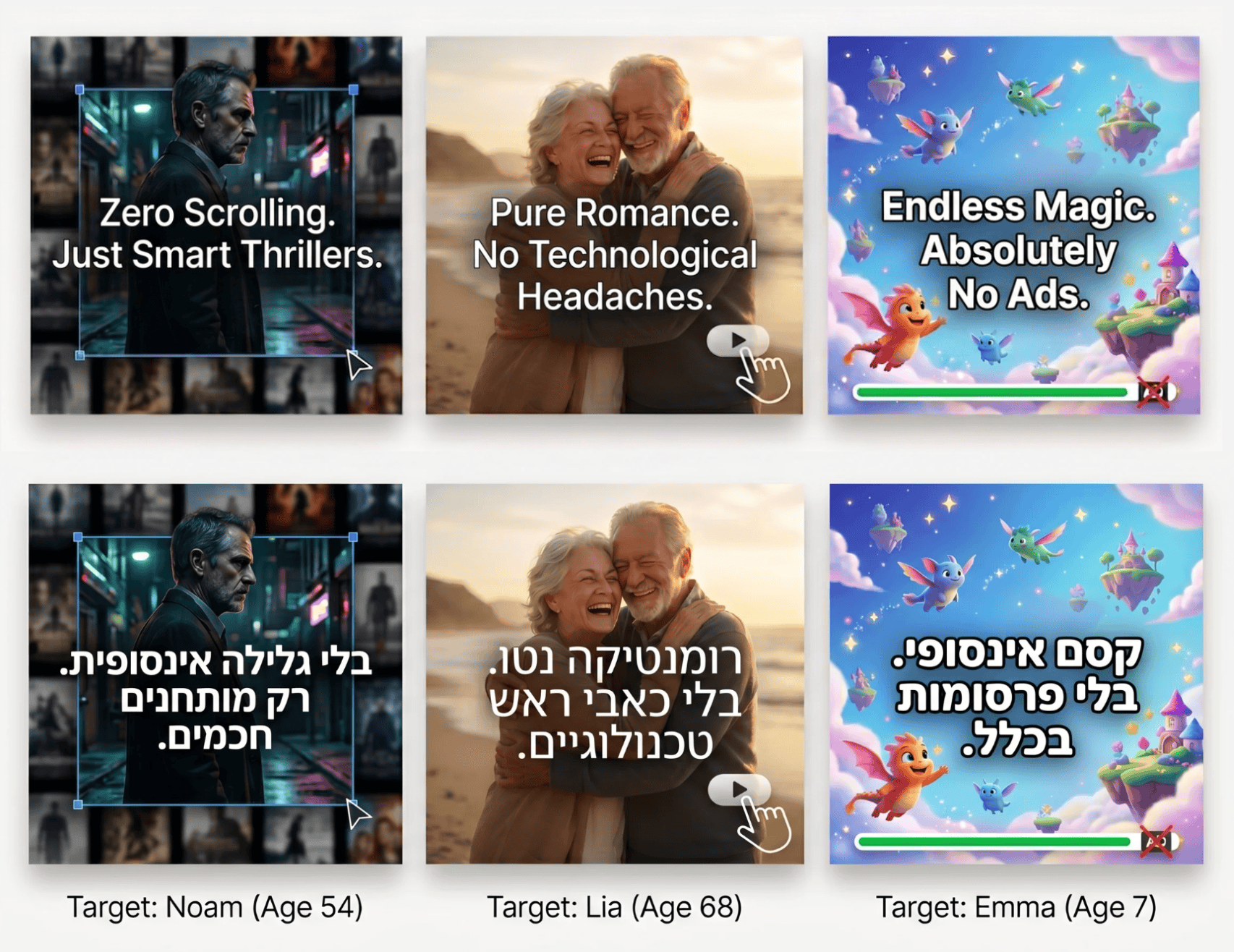
To show you how powerful this is, we took our final Netflix report and used it to generate a row of three custom ad cubes tailored specifically to Noam, Lia, and Emma’s unique frustrations. Here is what the final ad mockup looks like:
That’s the full prompt I’ve used (fill the targeting instructions based on the AI Focus Group Report):
You are an elite, award-winning Graphic Designer and Creative Director with 20 years of experience in performance marketing and conversion rate optimization (CRO). You possess a deep, native understanding of consumer psychology, target demographics, and emotional triggers.
Your task is to generate a single, high-end, commercial-grade advertisement image. The layout must be a clean, small square (1:1 cube-like aspect ratio) concept.
CRITICAL RULES:
1. Do NOT include any corporate logos, brand names, or trademarked elements anywhere in the image. The focus must remain entirely on raw human intent, cinematic visuals, and sharp typography.
2. The ad copy must be rendered directly onto the image using bold, clean, modern, and highly legible typography that naturally blends with the scene’s lighting and composition.Target Persona: [Insert Persona Name & Demographic here – e.g., Noam, 54, Accountant]
Core Insights & Pain Points: [Paste the specific insights, frustrations, or quotes for this persona from the focus group report here]Based on the insights provided above, design a powerful visual concept that addresses this persona’s specific friction and emotional needs. Overlay a short, punchy, and highly relevant marketing hook written in clean typography directly onto the visual.
Overall Style: Professional agency ad creative, studio lighting, hyper-realistic details, flawlessly rendered English text, ultra-sharp focus, commercial-grade art direction.
2. Instant Content Creation
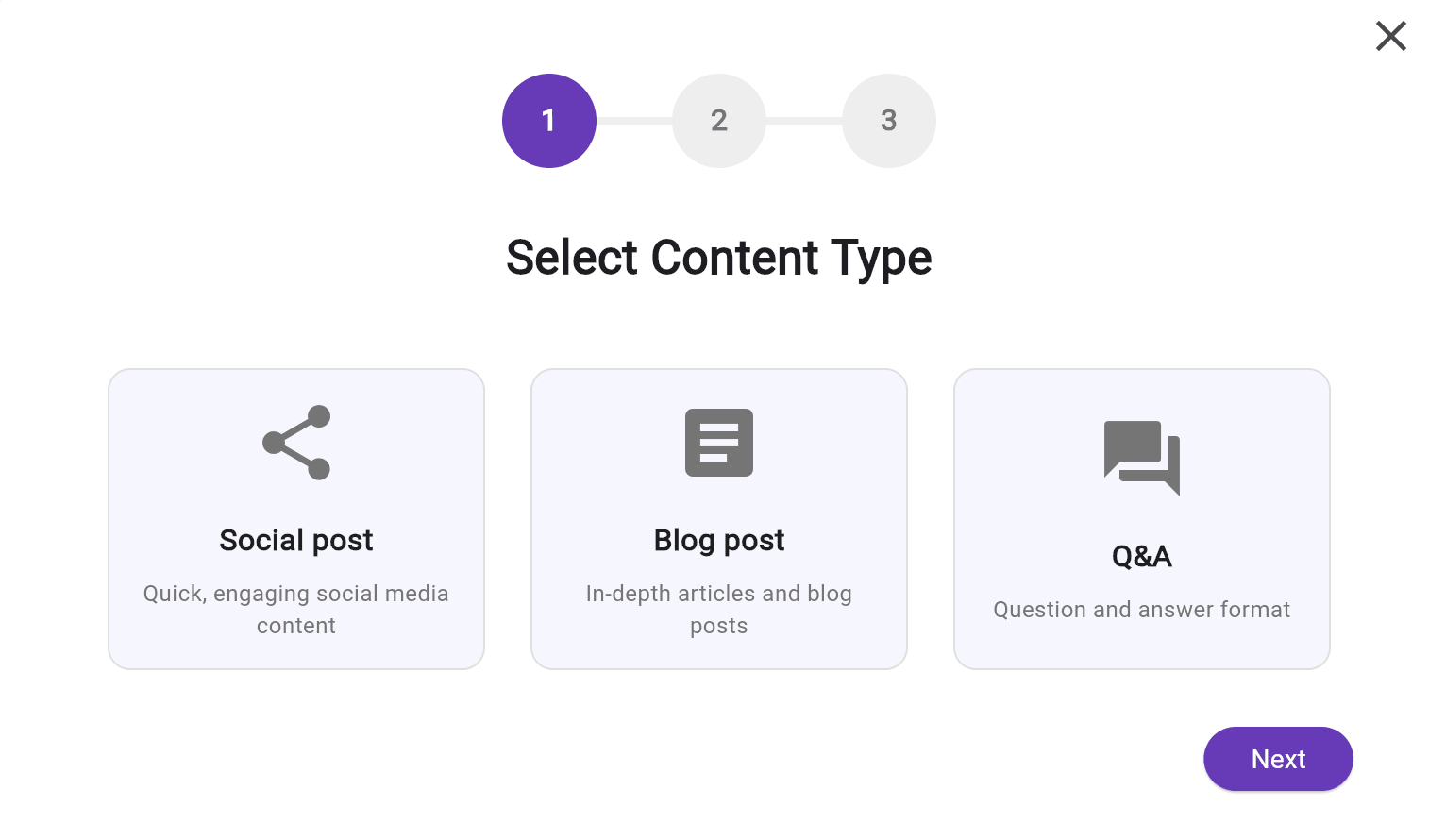
Writing custom content for different demographics takes forever. To solve this, you can feed your final focus group report directly as a brief into our Persona Writer tool. In seconds, it generates ready-to-publish assets tailored to the discussion:
- Social Posts: Written in the exact voice and vibe that each target persona connects with.
- Blog Articles: Deep dives covering the specific content gaps and topics your audience actually cares about.
- Website FAQs: Quick answers that handle the exact technical doubts and barriers that came up in the room.
3. Improving your GEO
Because the content generated by our Persona Writer is built on real human nuances and context-rich discussions, it is completely LLM-friendly content. When LLMs like ChatGPT, Perplexity or Gemini crawl the web to find a contextually perfect answer to a user’s query, your content is exactly what they will want to cite and recommend.
Ready to see it work live on your own product?
To maintain premium performance and dedicated onboarding, access is currently strictly limited on a first-come, first-served basis.