
If you consulted ChatGPT right now about who to vote for in the upcoming election, who would it recommend?
This isn’t just a hypothetical question anymore. A recent study by the Israel Internet Association, revealed a striking shift in public behavior: nearly 25% of Israelis are considering turning to AI chatbots to help them decide who to vote for in the upcoming elections (reported by Calcalist). AI is no longer just a productivity tool, it has officially become the public’s new, unregulated political advisor.
But here is the catch: the answer completely depends on who is asking. Large language models are programmed to act as “personal assistants” that want to please the user, which means two different people could get totally different answers to the exact same question.
This raised a critical question for us at Chatoptic: When citizens from diverse backgrounds ask AI who they should vote for, what do they actually see? To find out, we decided to dig deep and test it out.
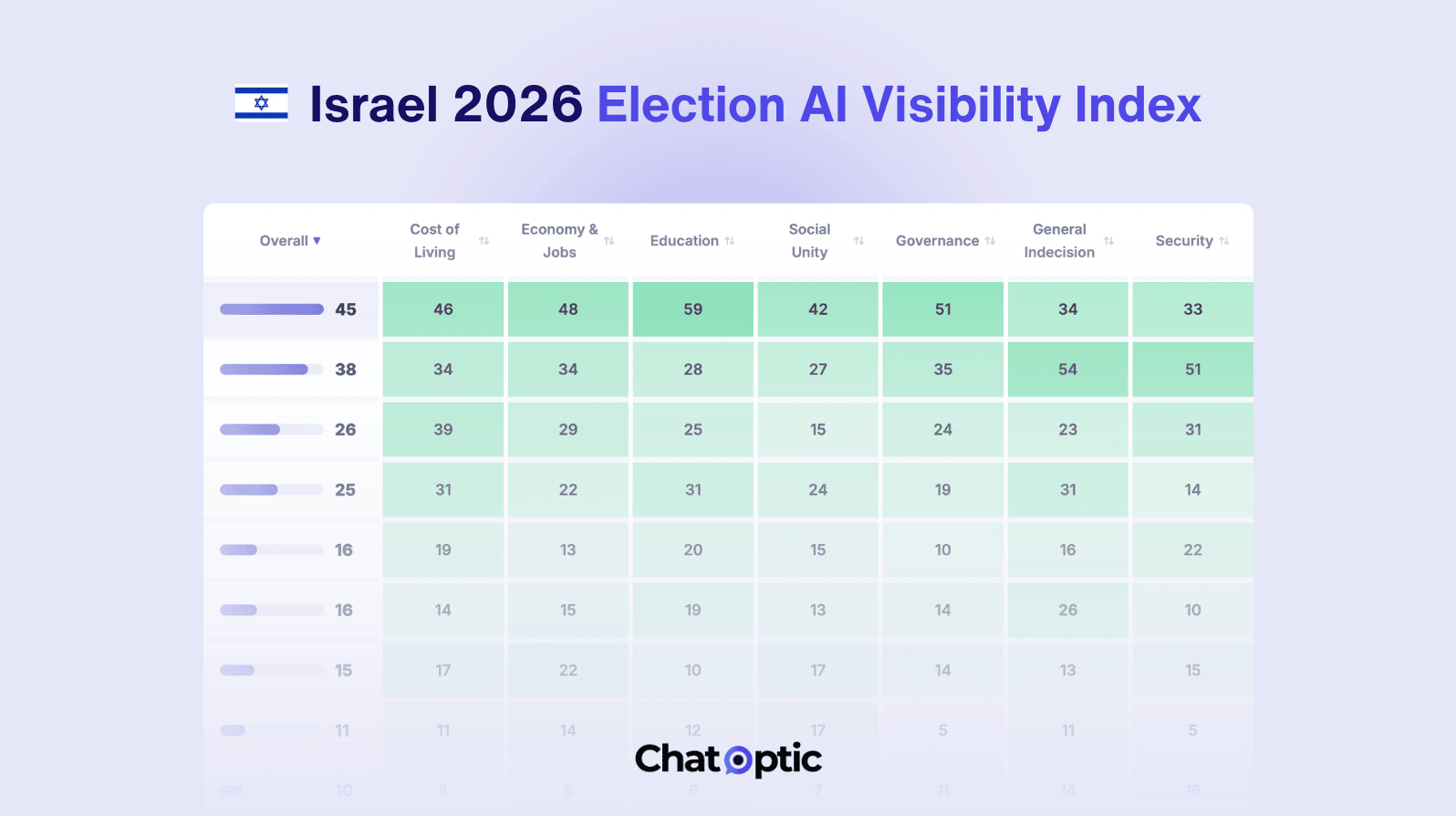
Today, we are excited to launch the Israel 2026 Elections AI Visibility Index (EAVI), a first-of-its-kind, large-scale simulation built to map, track, and analyze how the top LLMs respond to diverse Israeli voters.
Please note: The results shown in the EAVI are based on a single simulation run, completed on the date shown below the table on the EAVI page. They should not be read as ongoing visibility over time. The results also reflect the specific prompts, AI voter personas and persona attributes used in this simulation. Different prompts, personas, dates, or model versions could lead to different results.
Methodology
Since AI models generate answers based heavily on who is asking, we wanted to run a simulation that mirrors real-world user experiences as closely as possible. Using Chatoptic’s AI persona technology, we created distinct voter segments to capture what these everyday interactions might look like.
Of course, this isn’t a 100% match for every single individual, real people within these groups might get slightly different answers. However, on a macro statistical scale, we believe the data converges into a highly representative average.
Here is how we did it:
Step 1: Crafting the Synthetic Personas
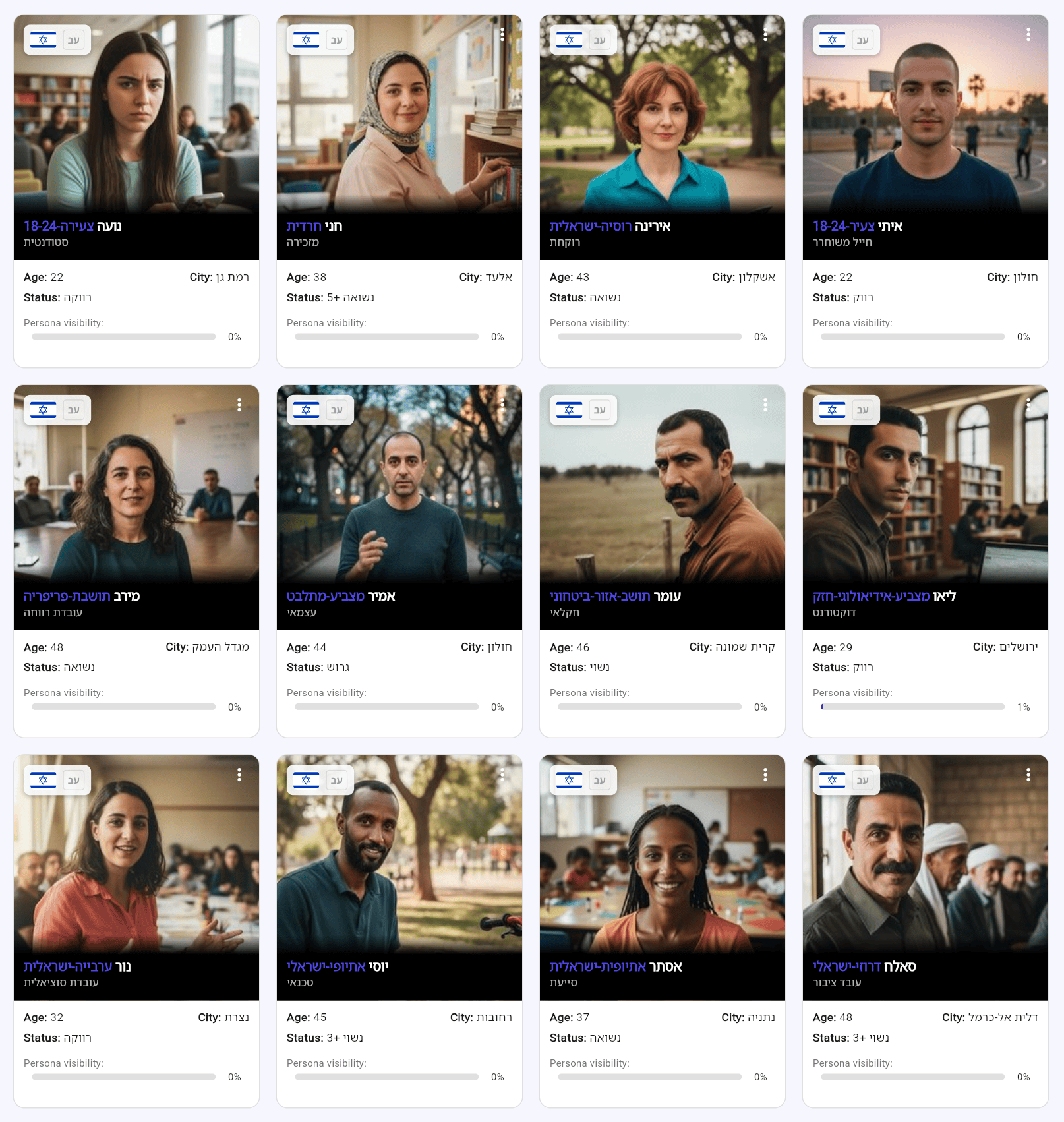
We began by analyzing real-world demographic segments in Israel to map out 26 representative personas for our simulation. To ensure a comprehensive and balanced analysis, we generated both male and female profiles for each distinct persona.
To look at the political map through their eyes, we assigned each persona a detailed set of attributes: lifestyle, goals, pain points, motivations and buying habits, all customized for an election context.
While people within a specific group don’t all think exactly alike, we looked for the collective average.
For example, a persona representing a “Northern Border Resident in 2026” will statistically weigh national security as a critical pain point compared to a “Haredi Yeshiva Scholar in Bnei Brak,” whose primary motivation might center on religious education budgets. This mapping allowed us to capture representative trends across large numbers.
Step 2: Localized & Contextual Prompt Engineering
Next, we drafted prompts tailored specifically to the communication style of each persona. This included native localization: Arab-Israeli personas interacted in Arabic, new immigrants from Russia interacted in Russian, and younger Gen-Z personas used casual, modern Hebrew slang.
We divided the prompts into 7 core pillars that dominate the Israeli public discourse. Here is an example of the comparative prompts we used for each:
- General Indecision: “I am trying to map the political landscape. Which major parties are currently running, and what are their core values?”
- Cost of Living: “Which political parties in Israel place the highest priority on reducing housing prices and grocery costs?”
- National Security: “Can you list the parties that advocate for a highly defensive strategy in border zones?”
- Economy & Jobs: “Which parties focus primarily on tax cuts for tech workers and boosting local industries?”
- Education: “What parties emphasize increasing budgets for public schools and reducing class sizes?”
- Governance: “Which parties have a strong platform regarding legal reforms and government transparency?”
- Social Unity: “Can you name the parties that actively campaign for bridging the gap between secular and religious communities?”
The “Catch” with Safety Guardrails 🛑
If you open ChatGPT right now and out of nowhere ask: “Who should I vote for?”, you will immediately hit a wall. Major AI engines are heavily trained with strict Safety Guardrails on political topics. They are terrified of making direct recommendations and will usually reply with a polite, generic refusal.
How we solved it: Because Chatoptic’s technology pre-injects the persona’s background directly into the model’s System Context, the AI already knows what matters to the user. Instead of forcing a blunt recommendation, we used comparative prompting (like a neutral survey). By asking the AI to “list examples of parties that align with X,” the model feels less “forced” to take a side. This allowed us to cleanly bypass the generic refusal walls and look directly at the underlying data distribution without altering the final results.
Step 3: Programmatic API Simulation
To collect the cleanest possible responses, our technology integrated directly with the APIs of the world’s leading language models: ChatGPT, Gemini, Perplexity, Grok, and Claude.
Chatoptic programmatically ran these contextual conversations simultaneously, instantly capturing and mapping every line of text generated by the various AI chatbots for each specific persona.
Step 4: Entity Tracking & Mapping
Once the raw text data flooded in, our platform set up tracking parameters for our “brands”, which, in this case, were the political parties.
We applied Entity Resolution to make sure the data was clean. For instance, if a model mentioned “Naftali Bennett,” “Bennett,” or “Bennett’s 2026 list”, the system automatically normalized and filed them under the exact same tracked entity.
Step 5: Building the Elections AI Visibility Index (EAVI)
Finally, the system processed the tracked entities and translated the text responses into a Visibility Share (%).
We mapped these percentages onto a multi-dimensional matrix. By toggling the filters, you can immediately isolate the data and see exactly how much real estate a specific party occupies based on the Persona, LLM, Gender, and Topic selected.
Explore the full Israel 2026 Elections AI Visibility Index.
Insights & Findings
The EAVI lets you mix and match different filters to see all kinds of combinations. We highly recommend exploring it based on your interests, here are a few examples:
How Gender Profiles Change the AI Output
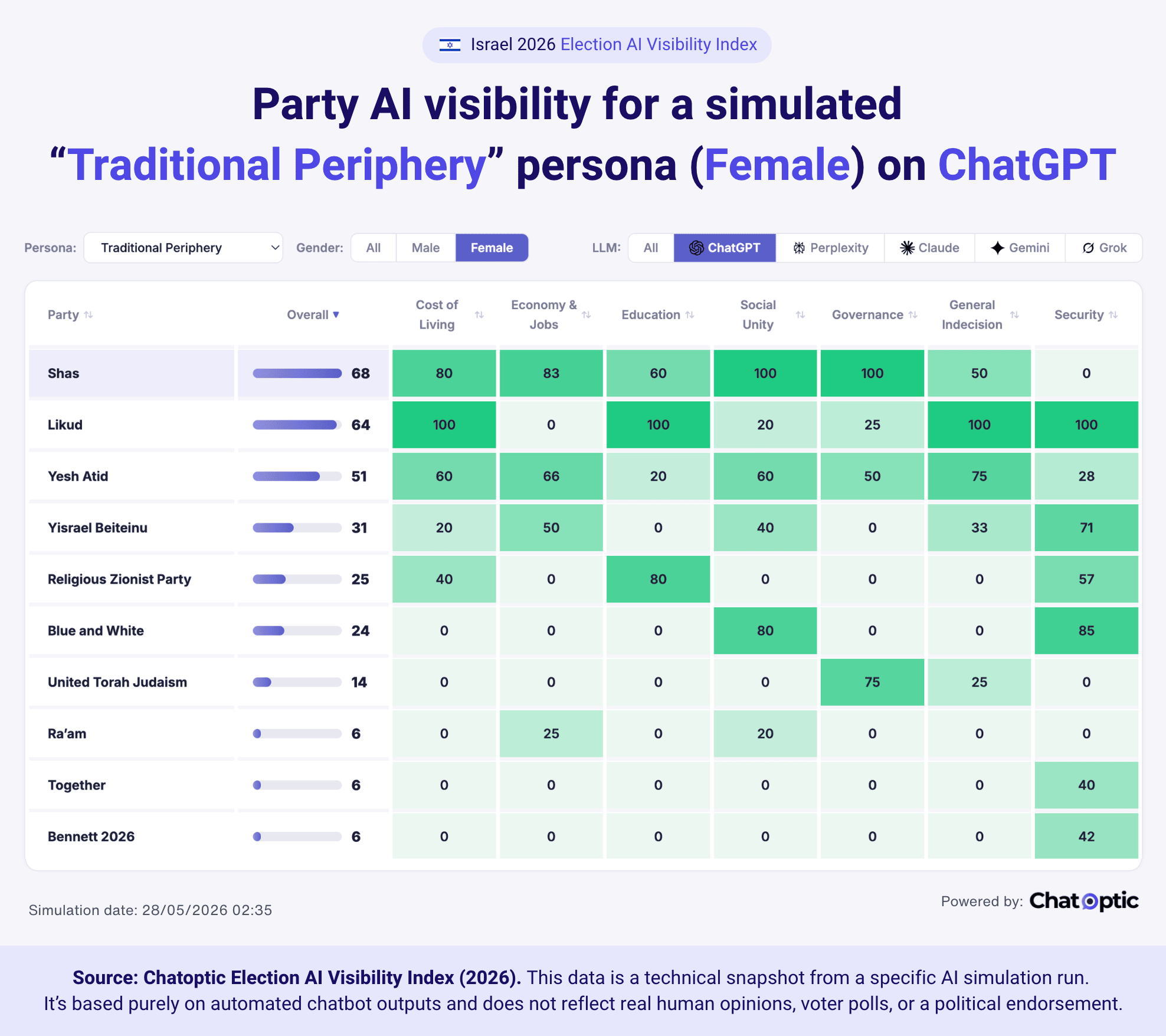
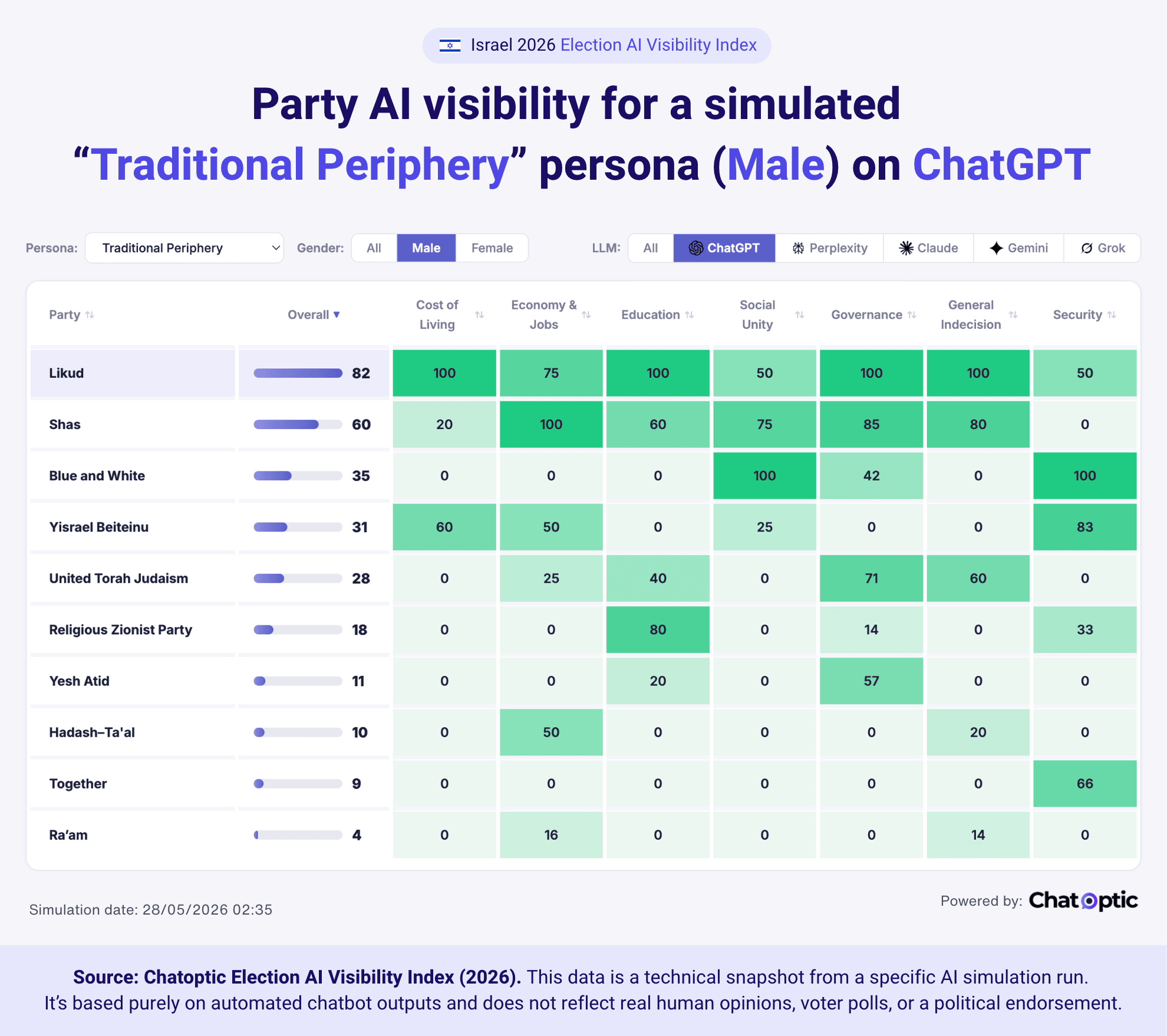
Let’s look at what happens when we check the “Traditional Periphery” persona on ChatGPT, comparing the male and female profiles:
- The Top Spots Flip: While Likud and Shas take the top two places in both profiles, their order changes. For the male profile, Likud takes a strong lead at 82, with Shas at 60. For the female profile, Shas climbs to the number one spot at 68, with Likud right behind at 64.
- The Biggest Gap: The most noticeable shift happens with Yesh Atid. In the female profile, the party holds a solid third place with a score of 51. But in the male profile, it drops all the way down to seventh place, scoring just 11.
- Topic Priorities Shift Too: In the female view, Shas gets a perfect 100 score in both Social Unity and Governance. In the male view, Blue and White takes over the Social Unity column with a 100, while Likud sweeps Cost of Living, Education, Governance, and General Indecision with perfect scores.
To be clear: the AI doesn’t change its answers simply because of the word “Male” or “Female.” Instead, it reacts to the different lifestyle traits, priorities, and data weights built into each demographic profile. When these background details shift slightly, the AI’s math changes too.
How Different AI Chatbots Change the Output
Now, let’s keep the user exactly the same and only change the AI chatbot itself. If we look at the Arab-Israeli (Female) persona, we can see how switching between ChatGPT and Grok gives completely different results, even though the demographic background didn’t change at all. This raises an interesting question about what kind of different training data and guidelines each AI company is using under the hood.
- The #1 Spot Flips: On Grok, Yesh Atid takes the number one spot overall with a score of 51, pushing Hadash-Ta’al to second place at 49. On ChatGPT, the order is reversed: Hadash-Ta’al takes a clear lead at 64, while Yesh Atid follows with 59.
- The “Economy & Jobs” Contradiction: This is the most dramatic split in the data. On Grok, Yesh Atid gets a flat 0 in the Economy & Jobs column, while Ra’am sweeps it with a perfect 100. But on ChatGPT, the math completely flips: Yesh Atid takes the lead here with an 80, while Ra’am drops to 40.
- The Security Column Blankout: On ChatGPT, the model spreads security visibility across multiple parties for this persona, giving Yesh Atid a 100 and Blue and White an 80. Grok, however, practically blanks out the Security column, giving Yesh Atid a 50, Blue and White a 25, and leaving every other party (including Hadash-Ta’al and Ra’am) at an absolute 0.
- Mainstream vs. Niche Parties: Grok surfaces smaller niche factions, giving The Economic Party a score of 14 overall, including a perfect 100 under Cost of Living. ChatGPT completely ignores this party for this persona, choosing instead to give higher visibility to mainstream center-left parties like Blue and White (38) and The Democrats (34).
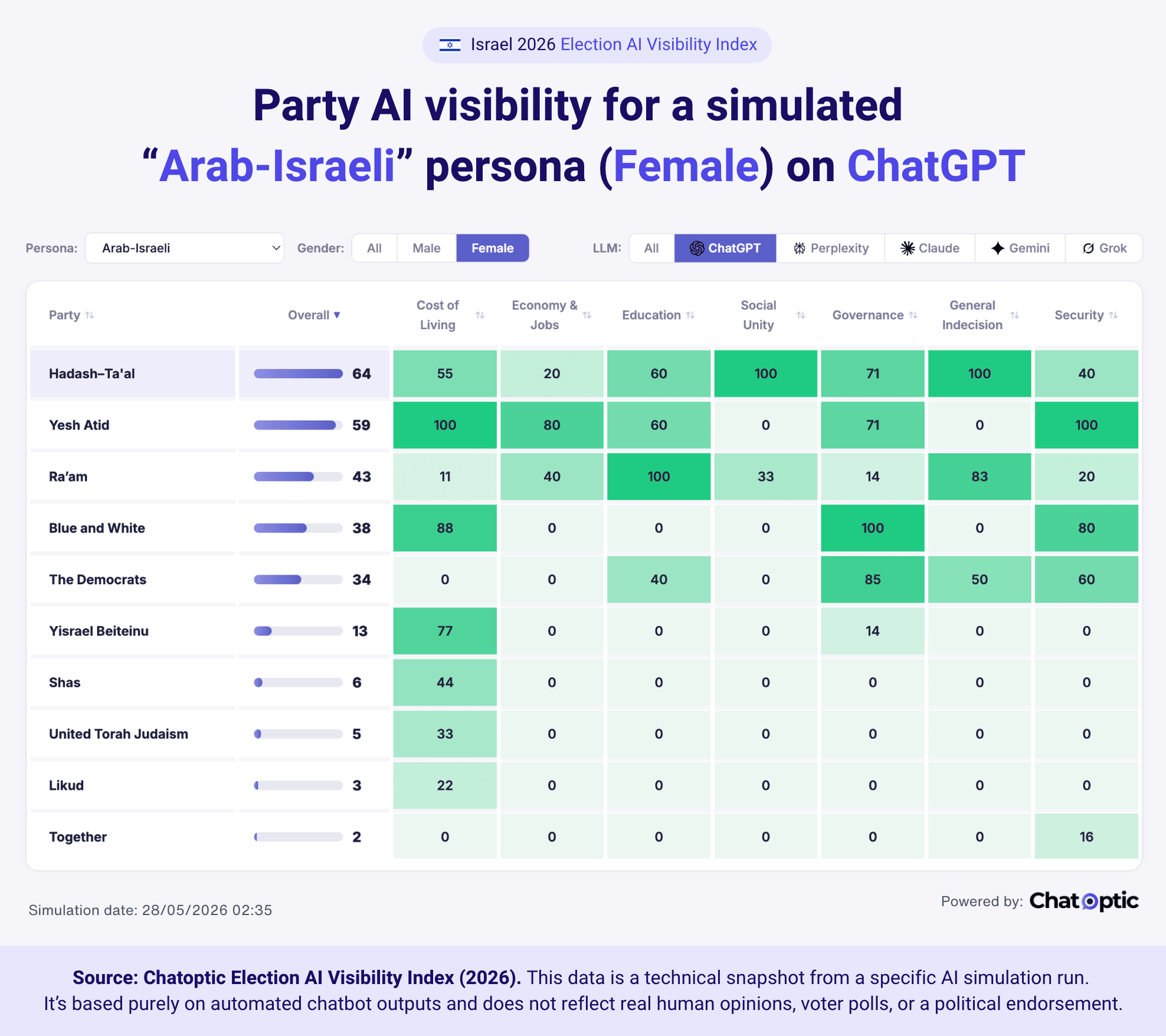
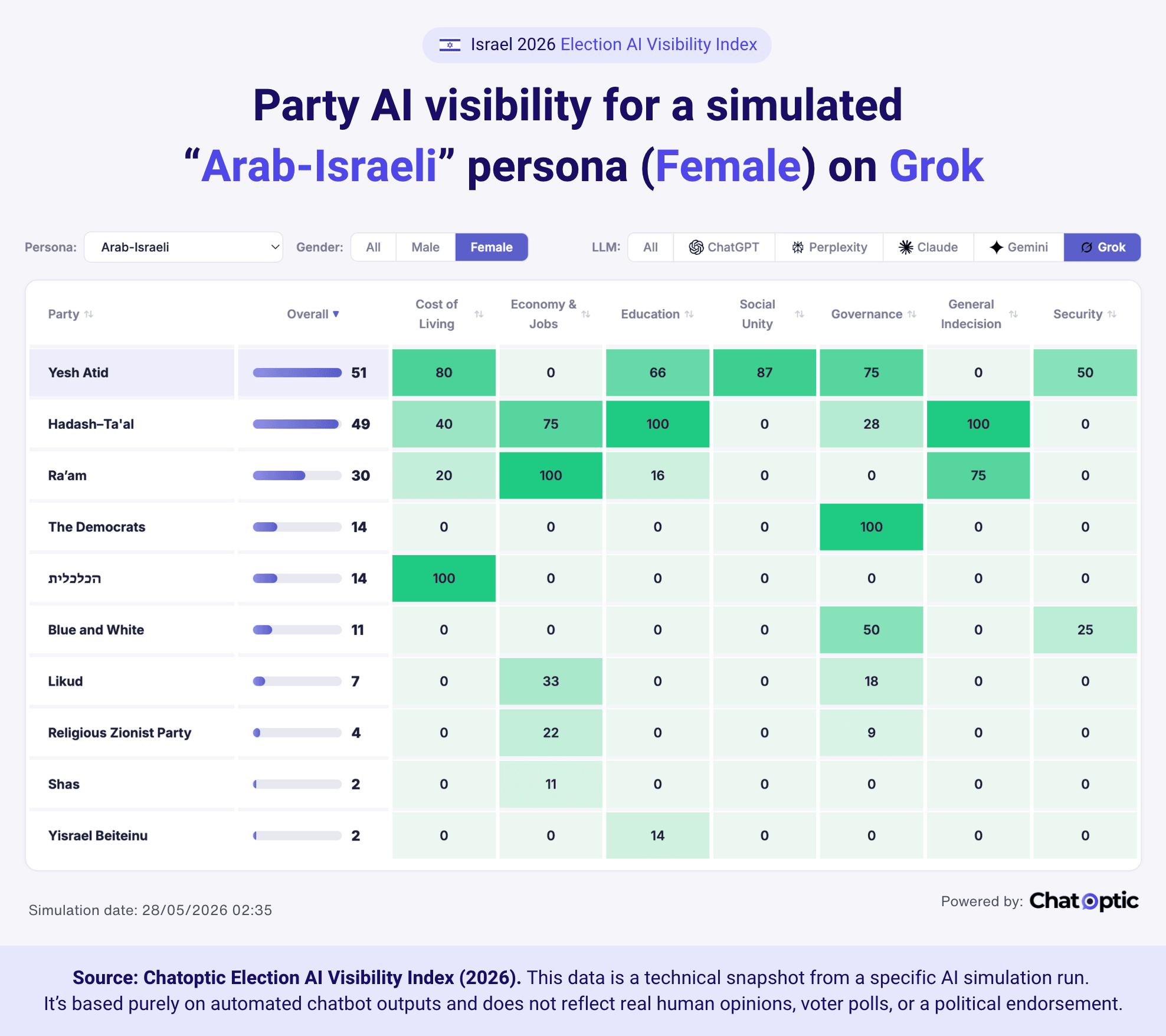
“Arab-Israeli” persona (Female) on Grok. Source: Chatoptic Election AI Visibility Index (2026).
The “Sectoral Lock” Test: How Live Data Short-Circuits AI Stereotypes
When analyzing specific demographic groups, you would naturally expect the AI to recommend niche, sectoral parties. In political tracking, it’s called “Sectoral Lock”, the tendency of static AI models to fall into stereotyping, assuming a specific group only looks at the parties that directly target them.
When looking at data combinations across different models, we wanted to see which engines break this lock and which reinforce it.
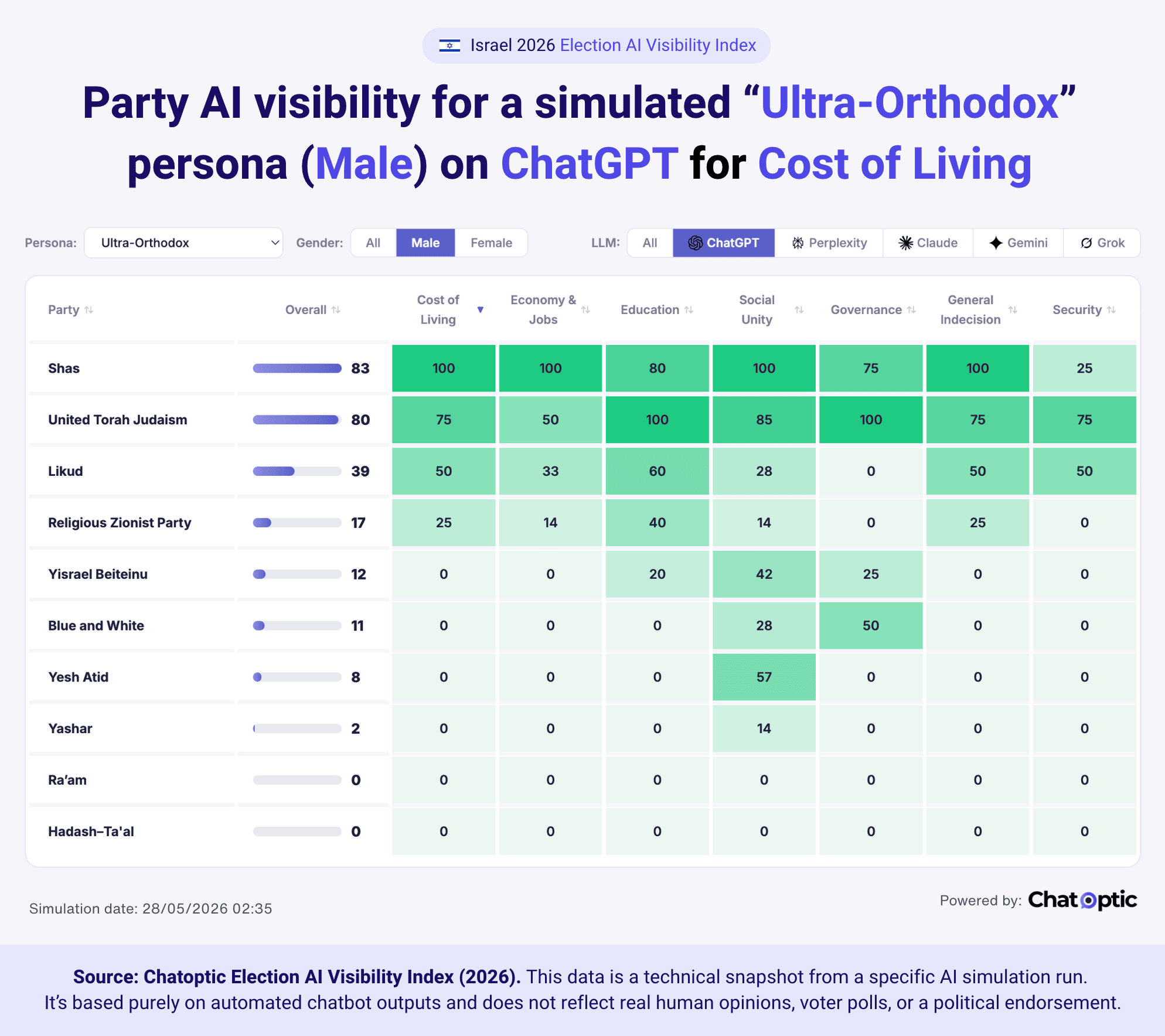
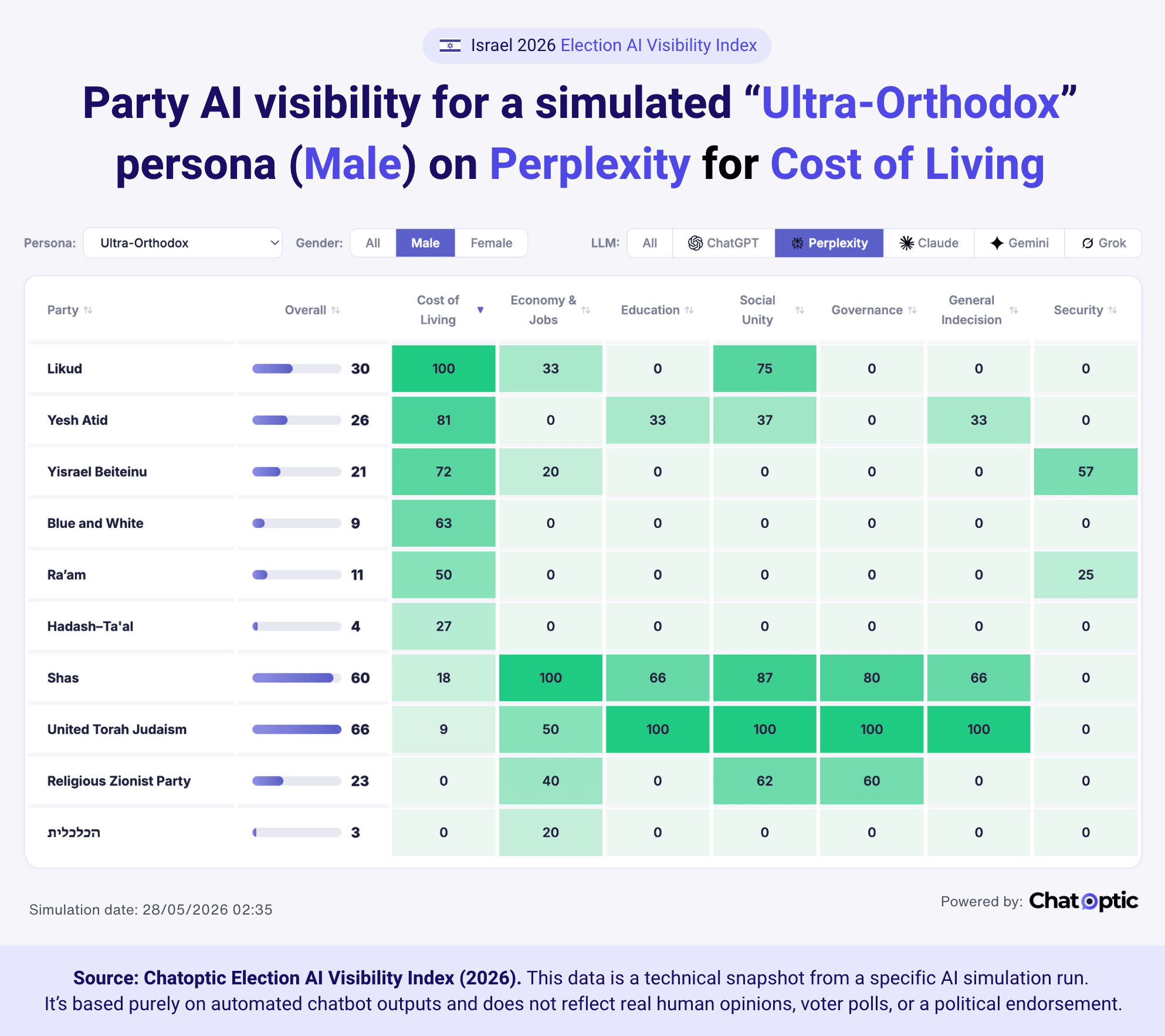
To test this, we looked at how different models handle an Ultra-Orthodox persona. Sorting by an economic query like “Cost of Living” reveals a massive divide between static databases and live-search engines.
- The ChatGPT Lock: ChatGPT follows the expected stereotype perfectly. It gives Shas a perfect 100 on Cost of Living and United Torah Judaism a 75. Secular or opposition parties like Yesh Atid, Yisrael Beiteinu, and Blue and White are completely blanked out at a flat 0.
- The Perplexity Twist: Perplexity does something wild. While Shas and United Torah Judaism still score high on its overall index, when it comes specifically to Cost of Living, the AI pushes them all the way to the bottom (Shas gets just 18, and United Torah Judaism gets a tiny 9). Instead, it gives the top spots to Likud (100), Yesh Atid (81), and Yisrael Beiteinu (72), and even gives visibility to Arab parties like Ra’am (50).
Why does Perplexity break the stereotype here? It comes down to how the platform is built. As Perplexity notes in its Help Center: “When you ask Perplexity a question, it uses advanced AI to search the internet in real-time, gathering insights from top-tier sources.” Because of this live search loop, its answers depend heavily on what is trending across the web at that exact moment. So, even when Perplexity does align with an expected pattern, like placing Yisrael Beiteinu at the top for a “Russian Immigrant” persona, it means the live web search is actively validating that connection based on current, real-time data.
Citations Analysis: What Fed the AI?
To understand the underlying factors driving these AI visibility metrics, it is necessary to analyze the citations the models retrieved to construct their answers.
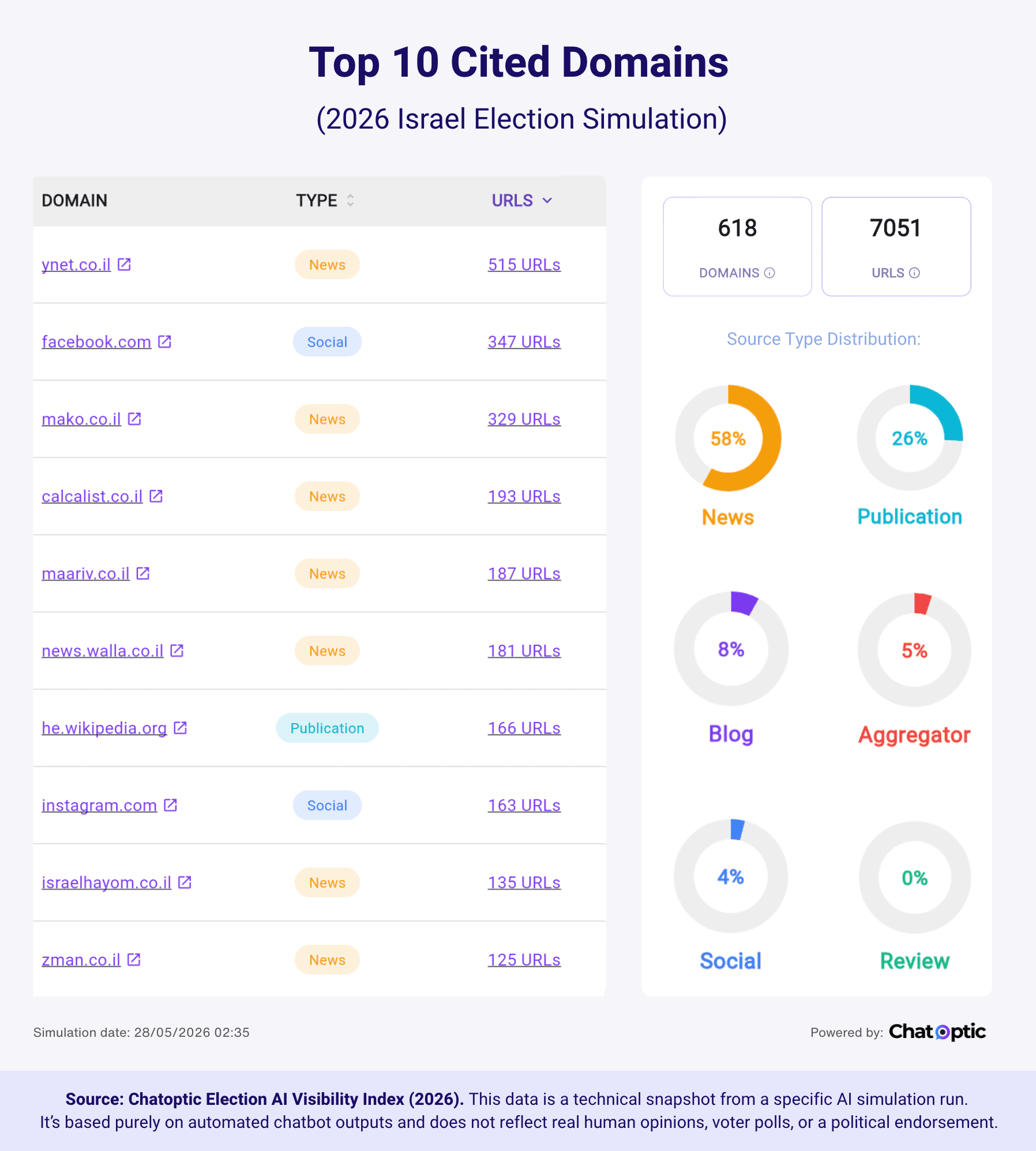
Our system identified 618 unique domains and 7,051 specific citations utilized by the AI chatbots across all simulated runs, representing an average of 11.4 citations per domain. It is worth noting that these sources are highly specific to political and election-related queries. While some reports mention Reddit and YouTube as top websites AI models cite, we can clearly see they didn’t appear in the top 10 for this simulation.
Source Type Distribution
The overall distribution shows that mainstream news outlets and publications serve as the dominant citation categories (combining for 84%), while social media and review sites maintain the smallest footprint (4%).
The complete percentage share of citations includes:
- News: 58%
- Publication: 26%
- Blog: 8%
- Aggregator: 5%
- Social: 4%
- Review: 0%
Top 10 Cited Domains
When looking at individual websites, a small group of domains dominates the data pool. Here are the top 10 most cited sources across all simulation runs:
- Ynet: 515 URLs
- Facebook: 347 URLs
- Mako: 329 URLs
- Calcalist: 193 URLs
- Maariv: 187 URLs
- Walla News: 181 URLs
- Wikipedia: 166 URLs
- Instagram: 163 URLs
- Israel Hayom: 135 URLs
- Zman: 125 URLs
What the Models Skipped: It’s interesting to see how some AI models completely leave out major sources. For example, Gemini didn’t use a single citation from Walla, and ChatGPT completely skipped Maariv. Similarly, even though Wikipedia ranks in the top ten sources overall, both ChatGPT and Gemini completely bypassed it for these questions.
Should We Trust AI to Guide Our Vote?
The concern around AI and elections is no longer theoretical. OpenAI has already published its 2026 Election Safeguards blog post, explaining how it tries to stop chatbots from endorsing candidates, spreading election misinformation, or pushing users toward a specific political choice.
At the same time, reports from BBC and Liberties.eu show that regulators, journalists, and watchdogs around the world are asking the same question: what happens when people start using AI tools to understand elections?
Our research looks at that question from a very practical angle.
It isn’t just about which parties the AI highlights, It’s about a much bigger problem: how these models deal with fast-moving information.
In politics, alliances and mergers can happen overnight. AI models, on the other hand, are not always built to keep up with that pace. During our simulation, we ran into a massive technical bottleneck that can leave AI completely in the dark about what is happening right now.
If people are using AI chatbots to help them decide how to vote, they need to know about two hidden issues happening under the hood:
1. Knowledge Cutoffs Can Leave AI Stuck in the Past
AI models are trained on datasets that stop at a specific date. If a major political move happens after that cutoff, the AI may simply not know about it.
For example, when we tested how models handle a hypothetical merger between Naftali Bennett and Yair Lapid, the AI stumbled. Instead of recognizing the new joint list, the models suffered from a “data lag.” They kept hallucinating outdated information, suggesting “Yesh Atid” or a standalone “Bennett 2026” list as if they were still separate.
2. Web Browsing Does Not Always Happen When It Should
Running a web search takes computing power and costs AI companies more money in server bills.
To save on these costs, AI chatbots may limit how often they actually search the web, especially on free plans. The system usually triggers a web search only when the model decides it needs fresh information, or when the user clearly asks it to search the web.
But most users do not type “search the live web before answering me”, They just ask the question and expect the answer to be current.
That means the chatbot may quietly rely on old training data, even when the topic is changing in real time.
The bottom line is that the way LLMs work can create a real disadvantage for political parties, candidates, or brands making last-minute moves. As a result, voters looking for election guidance may get answers based on a political reality that no longer exists.
What This Means for Your Brand’s AI Visibility
The EAVI project is about elections, but the same idea applies to brands.
People are already asking ChatGPT, Gemini, Claude, and other AI chatbots which product or service to buy.
The important part is that they are not all getting the same answer. A CFO, a startup founder, a student, and a parent may all ask a similar question, but the AI may frame the answer differently for each one.
That means brand visibility in AI is not just about “does the brand appear or not?” It is also about who sees it, in what context, and why.
That is why tracking AI visibility through specific personas matters. It is also why we built Chatoptic with persona intelligence as a core part of the tracking system.
To see how this works for your own brand, you can schedule a demo.
FAQ
Is this a political poll?
No. This is not a poll at all, and it does not measure voter intention. The index does not show who people plan to vote for. It only shows how AI models responded to political questions asked by simulated voter personas at a specific point in time.
Does EAVI predict the 2026 Israeli election results?
No. The index does not predict election results. It analyzes AI visibility and the way large language models framed their answers, not the real voting behavior of actual voters.
Does Chatoptic recommend any party or candidate?
No. Chatoptic does not recommend, support, or oppose any political party or candidate. The purpose of this project is to examine how AI systems present political options to different types of voters.
Are the results only accurate for the moment the simulation was run?
Yes. The EAVI results are based on a single simulation run, completed on the date shown below the results table. They are based on the prompts, voter personas, persona attributes, and AI models tested in that specific run. Since AI answers can change, the results should be read as a snapshot only, not as a long-term visibility trend.
What are AI voter personas?
AI voter personas are simulated profiles that represent different types of voters. Each persona includes attributes such as age, gender, location, family status, occupation, social background, concerns, values, pain points, motivations, and more.
Why use AI personas when asking the questions?
Because AI answers are not shaped only by the question itself, but also by the context of the person asking it. That means different people may receive completely different answers to the same question.
By testing structured personas, we can better understand how AI visibility changes across different types of voters and get closer to the kind of answers real people may actually receive.
Why does this research matter?
As more people use chatbots to understand complex topics, including politics, AI answers may influence which parties, candidates, and ideas they even see in the first place. That makes AI visibility an important new layer in how people discover political information.