
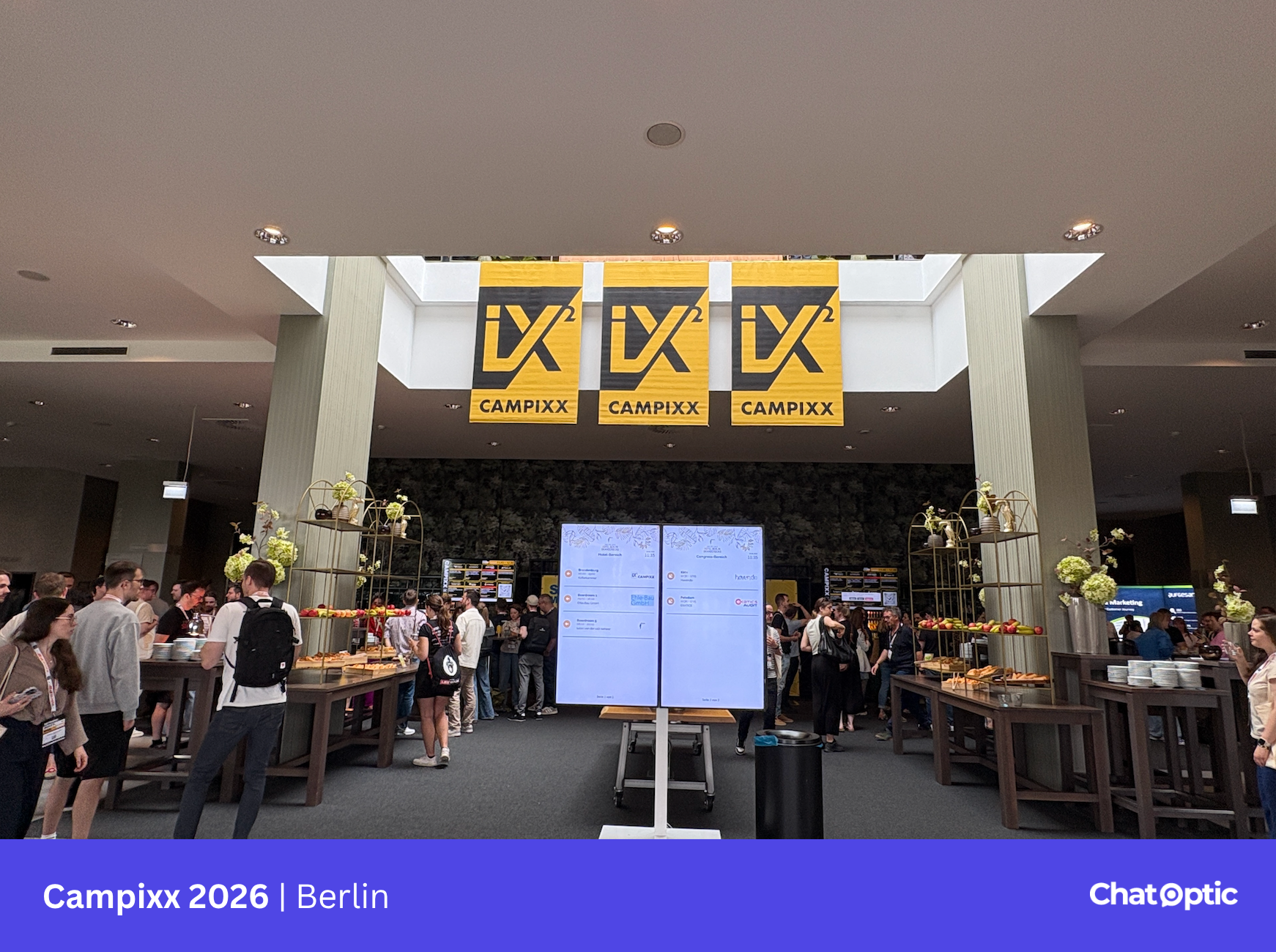
I just got back from CAMPIXX 2026 in Berlin, and I’m still trying to make sense of all the ideas and conversations from the event.
The biggest theme this year? Traditional SEO isn’t dead, but it’s officially no longer enough. As AI engines like Google’s AI Overviews and AI Mode, ChatGPT, and Perplexity completely rewrite the rules of how people find information, the game has shifted from chasing keywords to building absolute trust and brand authority.
To help you skip the fluff, I put together 30 takeaways straight from the international track, perfectly led by Sandra Karner:
What is CAMPIXX?
CAMPIXX is one of Europe’s leading and most recognized SEO and content marketing conferences since 2009, held annually in Berlin. It’s known for its unique atmosphere that prioritizes genuine networking, professional community-building, and highly practical, “eye-level” presentations.
This year, the conference focused heavily on the intersection of traditional SEO and GEO (Generative Engine Optimization), exploring the future of search in the era of Large Language Models (LLMs).
The 30 takeaways, stats and tips
How SEO & GEO work together: Do great GEO without destroying your SEO
 Lily Ray
SEO Expert at Amsive
Linkedin
Lily Ray’s keynote gave a very clear way to think about how SEO and GEO should work together:
1. GEO is not the new SEO, it’s just that since AI dramatically changed search, the new search behavior requires new skills, tactics, tools and approaches and the traditional seo alone is not enough.
The Takeaway: A common misconception is that GEO is replacing SEO. In reality, it’s simply an additional layer to our profession. User behavior has shifted since people are asking more complex questions, so we need to learn new tools and understand how LLMs process information. The foundations of technical and content SEO are still critical, but they are no longer enough on their own.
2. When a B2B brand publishes its own “best [category]” listicle that ranks itself as #1, Google’s AI surfaces (AI Overviews + AI Mode) may cite that listicle as a source but leave the self-promoting brand out of the actual recommendation 69% of the time.
The Takeaway: AI engines have become sophisticated enough to detect bias and self-promotion. If you create content ranking yourself first, the AI might use your piece as a data source but strip out the self-recommendation to remain neutral for the user. This highlights the growing importance of Digital PR and third-party mentions.
3. Google calls Reciprocal brand mentions and paying for mentions “inauthentic mentions” and warns against manipulating mentions for AI. History shows that when Google starts documenting something like this, it means they are building something to get rid this type of tactics (e.g. Helpful Content update).
The Takeaway: Just as Google fought link buying in the past, it is now policing the AI engine landscape. “Mention swaps” or paid brand mentions are flagged as “inauthentic mentions” according to Gary Illyes from Google. History teaches us that when Google officially warns against a specific tactic, the algorithm designed to penalize it is already in development.
4. Lily’s don’ts:
- SEO/GEO driven Comparison / Alternative Pages
- Self-promotional Listicles
- Prompt Injection in summarize with AI buttons
- Excessive AI Content Scaling
- Excessive use of Commodity Content
- Paid and Reciprocal Brand Mentions
The Takeaway: stop mass-producing basic, generic AI-generated content (AI Slop), avoid comparison pages created purely to manipulate algorithms, and don’t try to hide “prompt injections” in your text to confuse AI summarizing agents.
Further reading in Lily’s blog: It Works Until It Doesn’t: AI Content Strategies That Backfire
5. Lily’s do’s:
- Structured Data: schema is useful, but not a silver bullet for GEO.
- Markdown Variants (if requested by agents)
- Optimize content for different audiences by naming there your audiences and discussing their pain points (via Dan Shure’s Experts On the Wire Podcast)
- Llms.txt: not a silver bullet for AI search, good for agents.
- Open Knowledge Format: recommend Marie Haynes who’s doing good videos about it
The Takeaway: Help AI agents read you easily. Schema is still useful, but so is providing your content in LLM-friendly formats like Markdown or using the new llms.txt standard. Additionally, explicitly name your target audience within the content and discuss their specific pain points, this helps the AI map your content to relevant user queries.
6. Use Glippy chrome extension by Jan-Willem Bobbink for AI Agent-Readiness
The Takeaway: Glippy is a highly practical tool (a Chrome extension) that lets you test how accessible and “ready” your website’s pages are to be crawled and read by AI agents.
7. Use Semantic Direction analysis by Dan Hinckley. Decompose the query into its latent dimensions, then grade your content against evaluative quality, practice area, location and entity type. When a passage/chunk answers all 4 criteria is likely to rank higher and be referenced by generative engines.
The Takeaway: Move away from keyword focus and transition to semantic analysis. Understand the intent behind the query and ensure that every meaningful paragraph in your content includes four elements, for example (lawyer):
- Evaluative quality: what makes one “best” (results, settlements, credentials)
- Practice area: personal injury, not criminal defense or family law
- Location: Salt Lake City, with the local proof that comes with it
- Entity type: an actual firm, not a listicle about lawyers
Rich paragraphs containing all these elements act as perfect “chunks” that AI engines can easily extract and cite.
From Sources to Signals: Trust as the Next Competitive Layer in AI Search
 Heather Physioc
Chief Discoverability Officer at VML
Linkedin
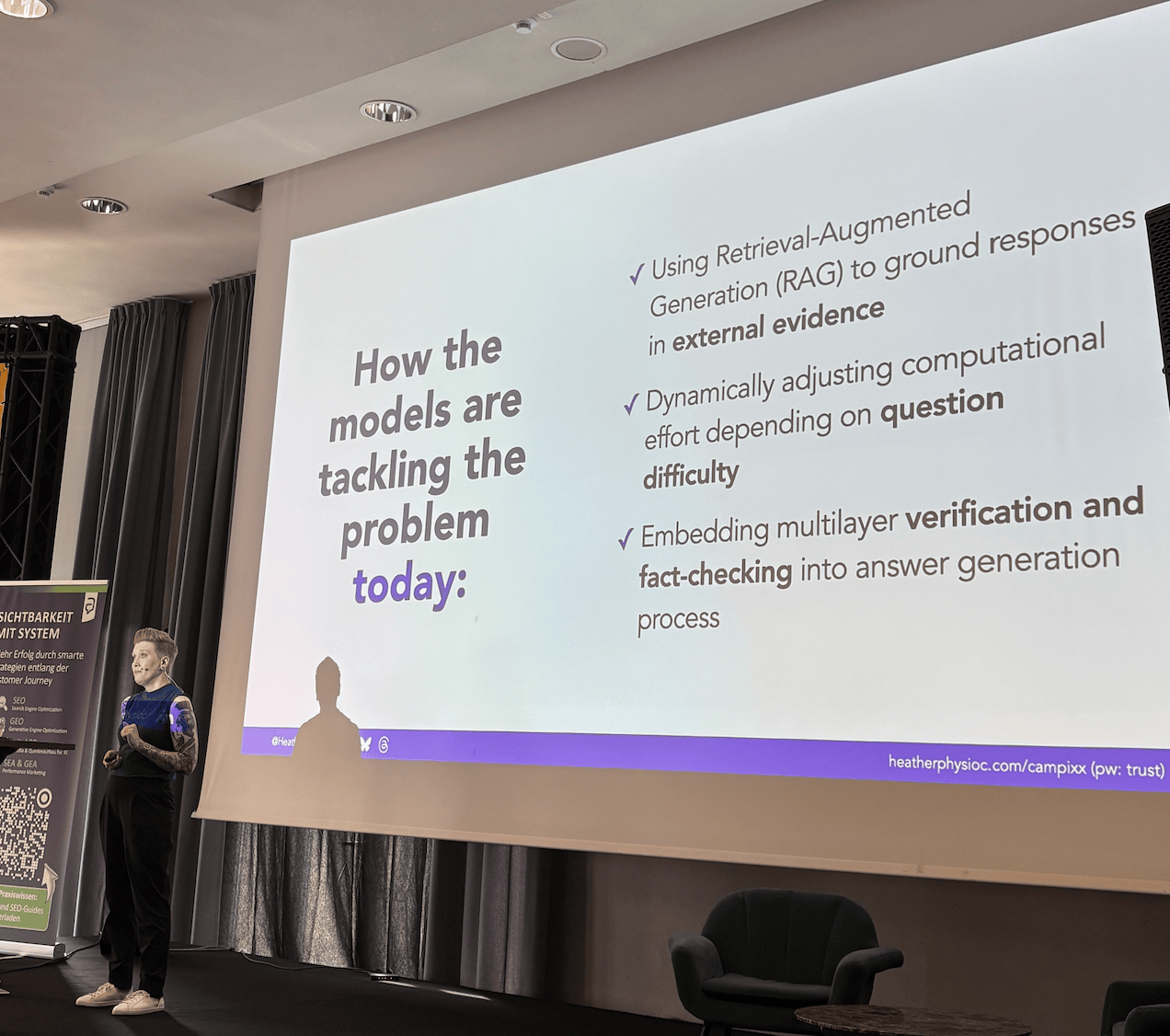
Heather Physioc focused on trust and confidence in AI search. The main idea: marketers should optimize for confidence.
8. Study found 1 in 10 Google AI Overviews answers is incorrect
The Takeaway: Despite rapid advancements, Google’s AI Overviews still get things wrong in about 10% of cases on average.
9. Hallucination rates range from 11% to 57%
The Takeaway: This statistic is both staggering and terrifying, between 11% and 57% (source) of answers provided by various language models contain hallucinations (incorrect or fabricated information).
For marketers, this means search engines are desperate for reliable sources to lower this rate, and it’s our job to provide that confidence.
10. How AI engines actually decide to trust your content: 1. Selection Signals 2. Platform Verification Signals 3. Human Trust Signals
The Takeaway: AI engines decide to trust your content based on 3 groups of signals:
- Selection Signals:
- E-E-A-T: Visible bylines, Author background info, Transparent sourcing
- Originality: Unique, first-hand perspective Original research Non-commodity content
- Human oversight: Identifiable human involvement, Expert editorial review, Distinguished from massproduced AI-generated slop
- Strong track record: Demonstrate a track record Be a trusted, reliable source in base memory
- Clear structure: Well-organized & logical Relevant multimedia embeds Easy to parse * display
- Semantic proximity: Frequent mentions/citations alongside other authority entities in an industry
- Platform Verification Signals
- Atomic Fact-Checking: Breaking down response into individual ”atomic facts” Verifying each claim against external evidence
- Entity Cross-Checking: Checking claims against Knowledge Graphs to verify accuracy (not just match keywords)
- Multi-Source Consensus: Cross-referencing multiple URLs Several reputable sites agree Outliers dropped
- Reasoning Guardrails: Checking AI internal logic Safety constraints Organization policies
- Pre-Storage Text Validation: Mathematical uniqueness analysis Detecting & discarding slop before saving to system database
- Anomaly Detection: Sudden, suspicious topic shifts Catching hijacked domains Detecting reputation abuse
- Human Trust Signals
- Originality & Value: Substantial new value Unique analysis or original research Not just copying or rewriting common knowledg
- Comprehensive Depth: Complete exploration of topic Could trust, bookmark or share Could be found in a published book
- Human-Centric Care: Demonstrates attention to detail Organized logically for human navigation Helpful intent, designed to help humans achieve goals & have satisfying experiences
- Honest Framing: Accurate summarization Avoids exaggeration, clickbait, shock value, sensationalism
- Clear Sourcing: Transparent authorship Evidence of expertise and experience Backs up claims, references sources Free of easily verified factual errors
- Professional Presentation: Carefully crafted Free of sloppy errors Not hastily mass-produced Inclusion of supporting multimedia
EEAT – Not a Signal. A system. Learn to audit, measure and improve it in 2026
 Tom Winter
Chief Growth & Founder at SEOWind
Linkedin
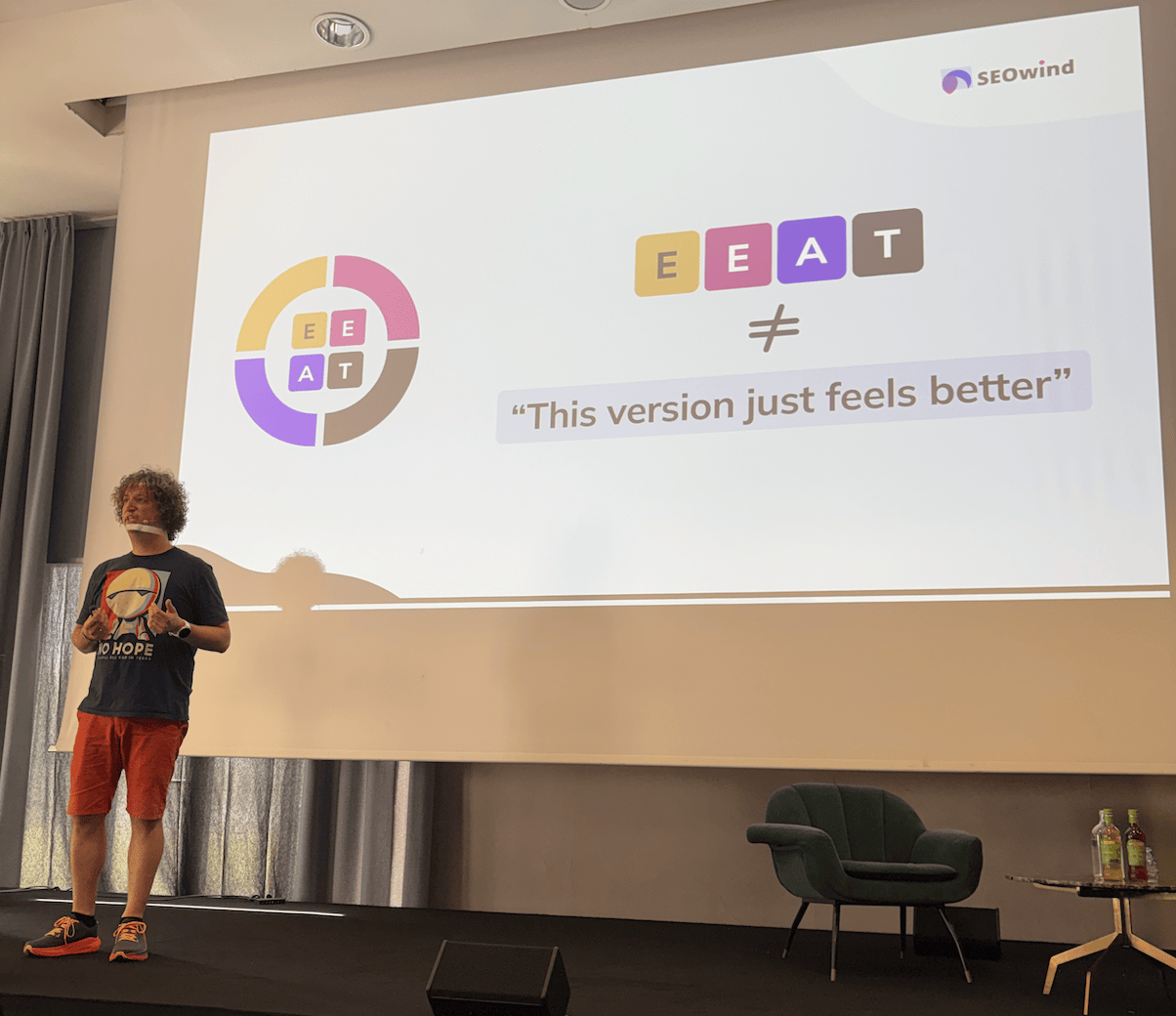
Tom Winter had a great reminder about E-E-A-T: It is not a signal, it is a system you need to measure.
11. E-E-A-T is measurable if you systematize it and ≠ “this version just feels better”
The Takeaway: You cannot treat E-E-A-T (Experience, Expertise, Authoritativeness, and Trustworthiness) as a “gut feeling” of quality. Writing “from my 15 years of experience” isn’t enough without proof, and you can’t fake trust by adding a shallow author bio or dropping a few Wikipedia links. It needs to be a structured, proven system.
12. The E-E-A-T manifesto: Don’t claim trust, prove it… If your content disappeared tomorrow, would anyone notice? Don’t just write to rank, write to be remembered.
The Takeaway: The most important rule of thumb for modern content: don’t claim you are trustworthy, prove it. LLMs can sniff out BS just as well as human users. The real test before publishing anything is asking: “If this content was deleted from the internet tomorrow, would anyone actually care?” Write to leave a mark, not just to catch a temporary ranking.
What AI knows about your business and what you can do about it
 Dixon Jones
SEO Expert at inLinks
Linkedin
Dixon Jones made a very practical point:
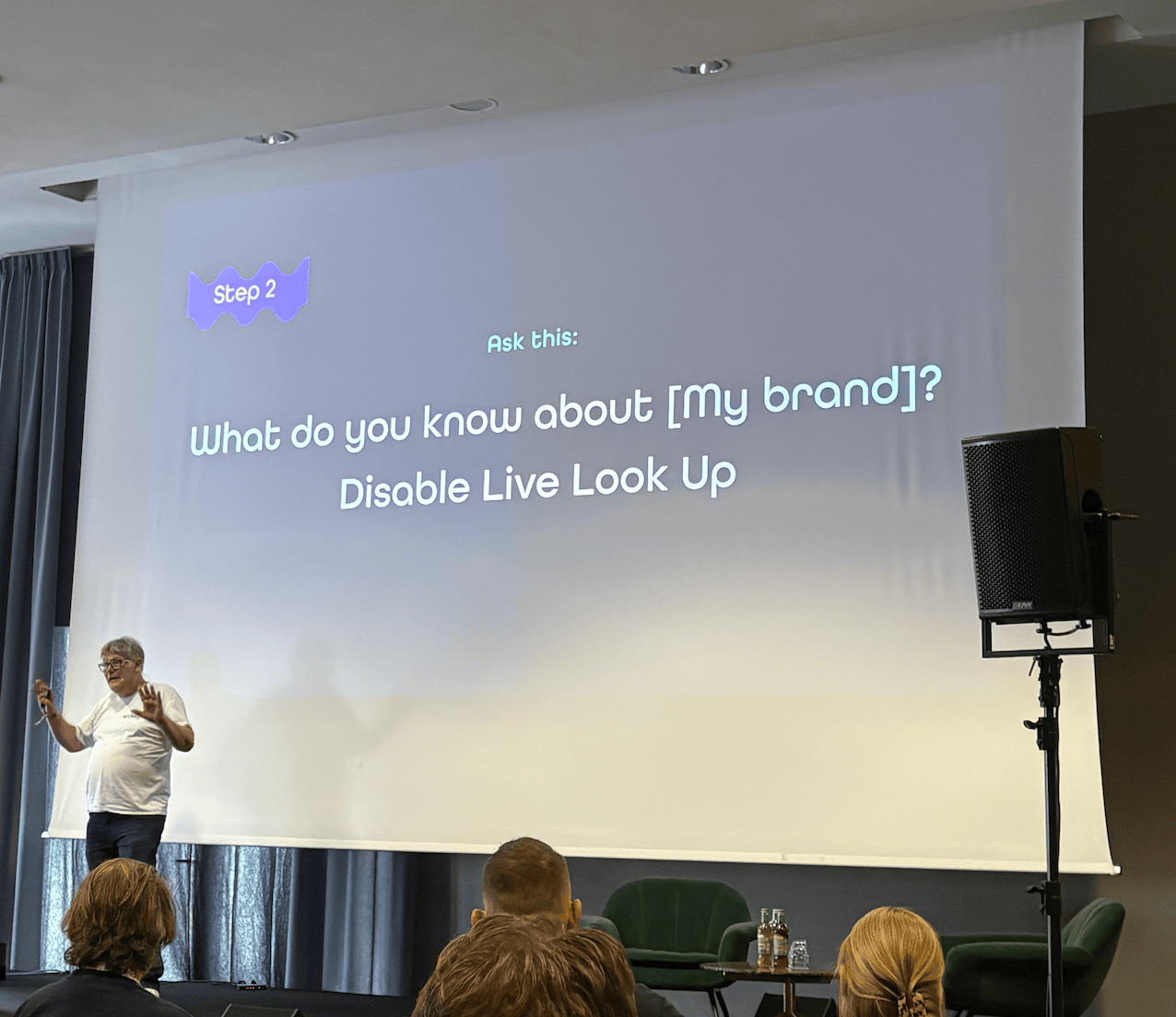
13. Before you start prompt monitoring, ask AI: “What do you know about my [brand]?” and “What do you know about my [brand] in the context of [topic]?”. Then compare the answer to the facts and look for what is wrong, missing or outdated.
The Takeaway: The most practical way to start GEO: just open ChatGPT or Claude and ask what they know about your company. The missing data, factual errors, or outdated features are the exact “information gaps” you need to fix through PR, website updates, and third-party mentions.
14. Use EntityMap.org to boost citations
The Takeaway: EntityMap.org is an incredible tool that maps which “entities” (concepts, people, products) exist in your competitors’ content but are missing from yours.
Closing these semantic gaps helps the engine understand exactly what you are talking about, leading to massive boosts in citations. Case study: 267% boost within 7 weeks only with this change.
Context (not Content) is King in AI Search
 Lazarina Stoy
SEO Expert at MLforSEO
Linkedin
Lazarin Astoy went deep into how AI search systems work.
15. Simply establishing a Trustpilot profile moved citation from from 1% to 53.5%
The Takeaway: This might be the most mind-blowing stat from the conference. Brands with no review profile in Trustpilot were cited in 1% of AI answers. Brands with active profiles: 75.3%. Simply establishing a Trustpilot profile moved citation from from 1% to 53.5% (based on 2026 study of 800,000 AI responses). Social proof translates directly into GEO visibility.
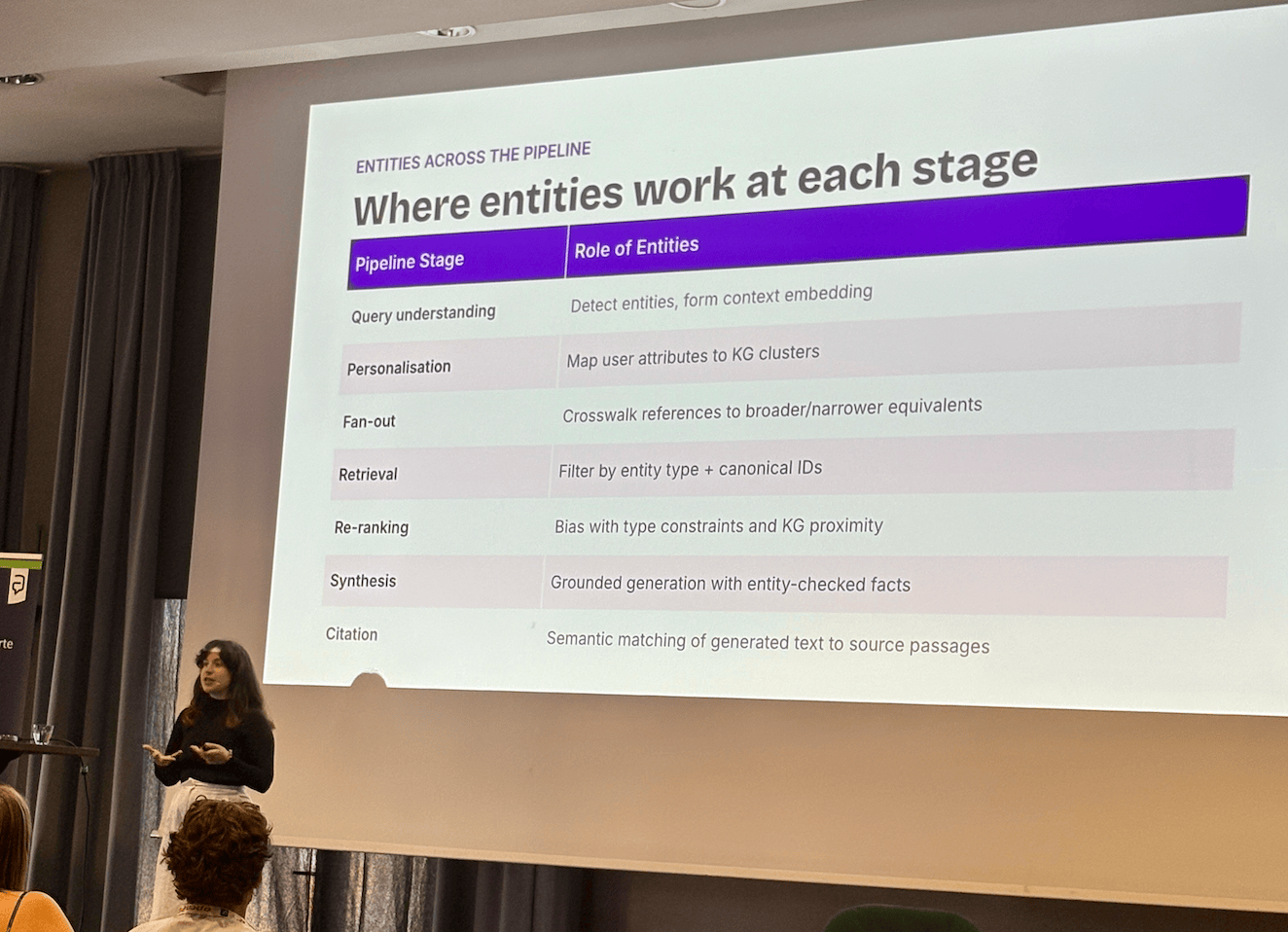
16. If your entities are not clear at the query understanding stage of the LLM pipeline, every stage that follows becomes weaker: personalization, query fan-out, retrieval, reranking, synthesis and citations.
The Takeaway: The LLM pipeline is built in stages. If the engine cannot sharply identify your entity (your brand) right at the initial query understanding stage, the entire chain that follows: retrieval, reranking, and final synthesis, will simply bypass you in favor of competitors with clearer digital identities.
17. LLMs build trust from consistency. Brand name, descriptions and key claims should be consistent across your site, LinkedIn, GBP, Wikipedia, PR and other third-party mentions.
The Takeaway: Language models love consistency. If your LinkedIn description differs from your Wikipedia page, and a PR article claims something different from your ‘About Us’ page, it creates a Data Conflict. When the LLM is confused, it’s less likley it will recommend it.
18. Topic clusters should evolve into entity networks: entity hubs, supporting content and connected relationship schema using @id.
The Takeaway: Topic Clusters have evolved. Instead of just linking between pillar and cluster pages, we need to convert into Entity networks. The old approach only works for traditional SEO, whereas the new approach works for both SEO and GEO.
- The old approach (Topic Clusters): Dictates creating Pillar pages that are supported by underlying Cluster pages.
- The new approach (Entity Networks): Involves creating Entity Hubs with supporting content, gluing them together using a linked relationship schema via @id that connects the person, organization, product, and concept.
Of course, you must ensure that every paragraph stands on its own for direct citation.
19. LLMs synthesize brand narratives from thousands of data points. If you want to shape how your brand is described, make sure you have: 5-7 canonical sentences repeated consistently… and 8-10 attributes associated with your brand…
The Takeaway: If you want to control your narrative inside answer engines, you have to plant it:
- 5–7 canonical sentences: Use the exact same phrasing across your About page, LinkedIn, Wikipedia, PR, and author bios in guest posts.
- 8–10 attributes to associate with your brand: Each backed by 1 deep-dive article, 3 pieces of social proof, and 5 third-party citations.
How to do e-commerce technical SEO for AI search
 Jairo Guerrero
SEO Expert at Organic Hackers
Linkedin
Jairo Guerrero shared useful technical SEO and AI Search tips for ecommerce:
20. Pages weighing more than 2MB will be cut from Google’s crawl effort.
The Takeaway: Google and AI crawlers operate under stricter resource limits than ever. A page weighing over 2MB simply won’t be fully crawled, meaning a large chunk of your content won’t even make it into Google’s index.
21. A page that loads in less than 2.5 seconds increases its chances of being cited by AI by 1.5x.
The Takeaway: Load speed is no longer just a traditional SEO signal (Core Web Vitals). AI engines generating real-time answers for users prefer retrieving information from sources that respond quickly.
How to do content updates on commercial pages in 2026 [backed by 100 Tests]
 Alex Galinos
SEO Expert at Elife Group
Linkedin
Alex Galinos showed a strong AI agent workflow for content updates.
22. To figure out which pages actually need a refresh, start with GSC data to find ranking decay and use Ahrefs to close topic gaps.
The Takeaway: Don’t refresh content based on gut feelings. The proper workflow is using Google Search Console to identify pages experiencing ranking decay, then cross-referencing that data with Ahrefs to find which topics your competitors are covering that you are missing.
23. Use seotesting.com to connect GSC to Claude, it’s a great integration for this.
The Takeaway: Connect GSC data (via a platform like Seotesting) directly to an LLM like Claude, letting it analyze the gaps for you and suggest exactly how to update and expand the existing page.
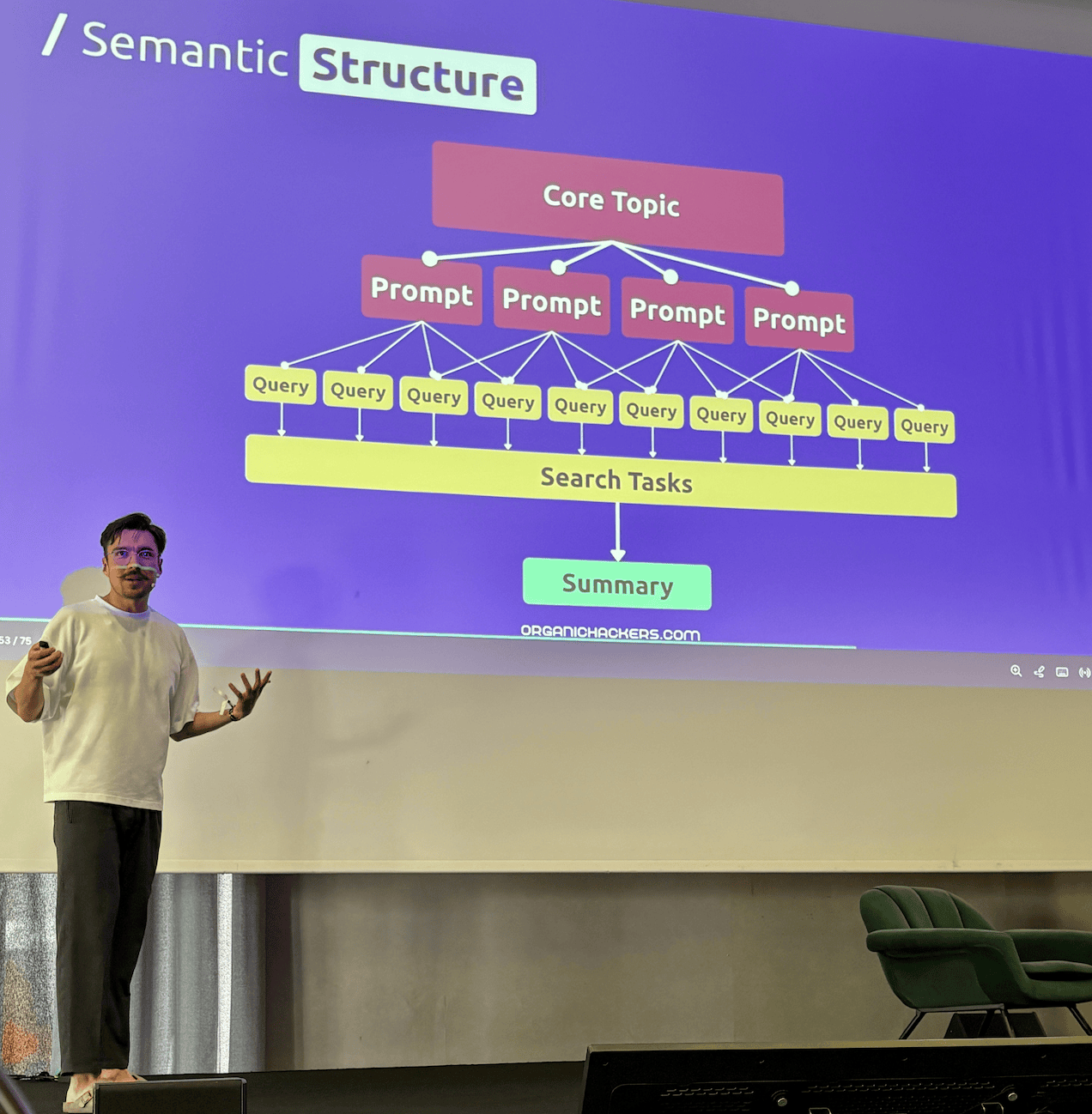
24. Build personas from real query data in GSC, validate those personas with query fan-out.
The Takeaway: This is brilliant, instead of inventing imaginary buyer personas (“David, the 35-year-old CMO”), build them using the actual search query data driving traffic to your site.
This is exactly where the tools we are building at Chatoptic fit in perfectly. Our platform allows you to generate AI personas based on highly precise context, mapped directly to user intent and demographics, saving hours of research and keeping your content hyper-targeted. We also recently launched Chatoptic Persona Writer, designed to generate LLM-friendly content tailored to specific target audiences.
25. When you update a page, try adding some ‘vibe coding’ elements like carousels or tables. It makes the info look way more visual and much easier for people to read.
The Takeaway: Updating content isn’t just about adding more text paragraphs. Utilizing “Vibe Coding”, embedding visual elements like tables, bullet points, and carousels, helps break up reader fatigue. More importantly, it helps AI engines quickly grasp the structure and hierarchy of your information.
!["How to do content updates on commercial pages in 2026 [backed by 100 Tests]", by Alex Galinos at Campixx 2026, Berlin](https://www.chatoptic.com/wp-content/uploads/2026/06/Screenshot-2026-06-23-at-15.07.08.png)
Help, my AI is better at outreach than I am: A Steal-My-Stack Session
 Bibi the Linkbuilder
SEO Expert at BibiBuzz
Linkedin
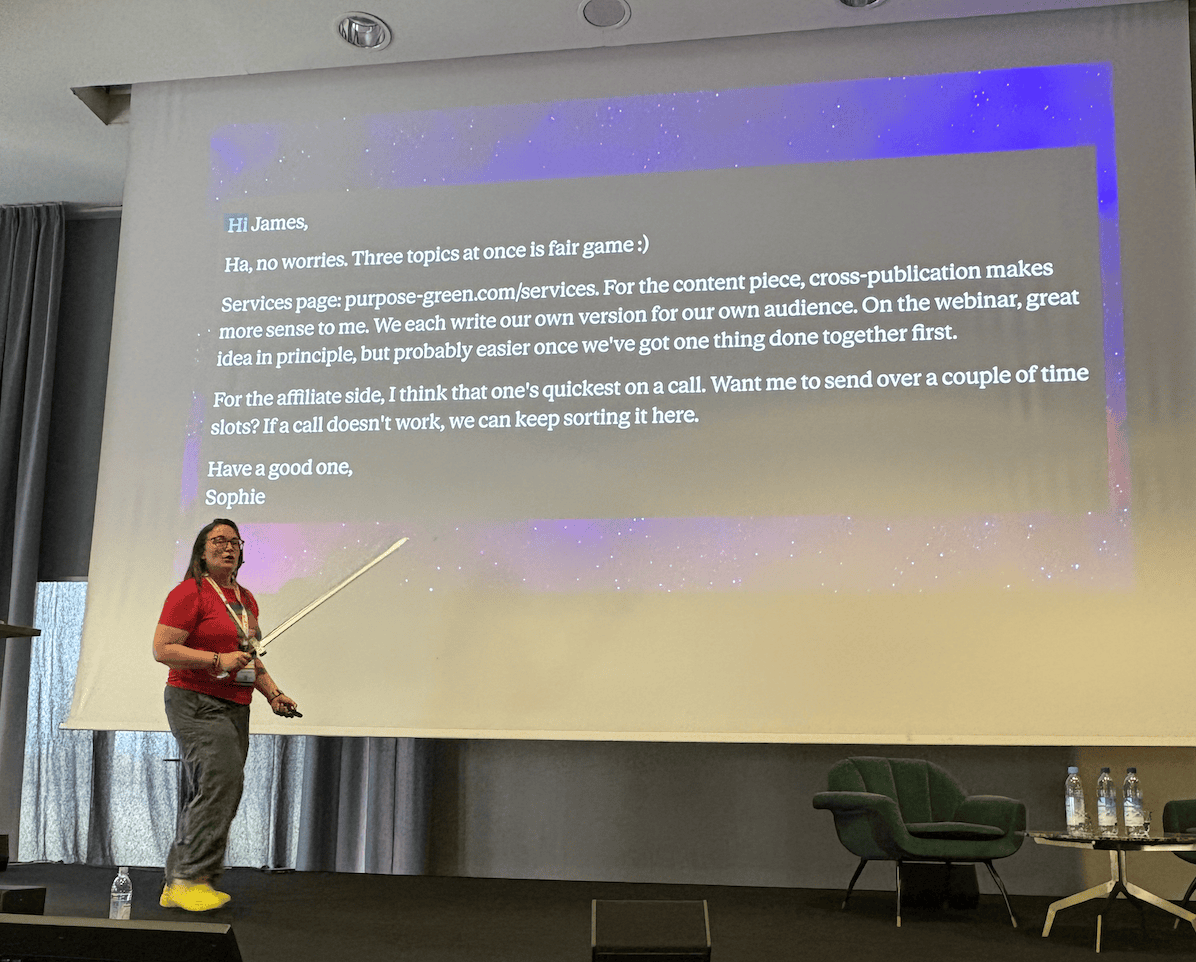
Bibi the Linkbuilder shared the Claude workflow she uses for AI-assisted outreach.
AI outreach is not just about asking Claude to “write me an email”. It works better when you build a full workflow around custom instructions, banned phrases, prospect vetting, outreach angles, draft emails and reply handling.
The Takeaway: The real value of AI in outreach is not sending more generic emails faster. It is turning the messy parts of outreach into a repeatable process, from researching the prospect and finding the right angle to drafting, checking and replying in a way that still feels human.
Beyond the SEO Silo: How to drive AI visibility across your entire organization
 Mike Korenugin
SEO Expert at SE Ranking
Linkedin
Also some useful tips from Mike Korenugin:
26. AI traffic doesn’t magically boost Direct, Brand, or Social. That assumption is dead.
The Takeaway: People used to assume that traffic from AI searches would magically lift direct visits, social and brand power. The stats show this simply isn’t true.
27. Most AI traffic lands on your homepage, those users already know you and have high intent.
The Takeaway: When a user asks an AI chatbot like ChatGPT or Perplexity about you and clicks a link, they usually land directly on your homepage. They already have a high level of awareness and much higher conversion intent compared to regular organic traffic.
28. For brand queries, AI prioritizes your homepage, review sites, and core social (LinkedIn/FB/IG), unlike Reddit and YouTube, which dominate general search.
The Takeaway: In generic Google searches, the platform currently pushes a lot of Reddit and YouTube content. But for brand queries (when someone searches your name in AI), the algorithm clearly prefers to display your core assets: your homepage, professional review sites, and official social media channels.
29. AI attribution is broken. Brands like Buffer, Tally, and us (SE Ranking) rely on onboarding questions to track it. Shockingly, 30-40% of signups come from this blind spot.
The Takeaway: Most analytics tools still can’t accurately tag traffic coming from AI engines. The best current fix is very “old school”, simply adding a “How did you hear about us?” question to your onboarding flow. Large companies have been shocked to discover that 30% to 40% of their signups came from AI recommendations, even though this data was invisible on their dashboards.
30. The SEO order of operations: Fix UX, product, and content before crawling. Fix crawling before indexation.
The Takeaway: A vital reminder of the proper, unchanging workflow. Don’t obsess over Google indexing issues until you’ve ensured your User Experience (UX), product quality, and content quality meet the standards. If those are broken, no technical fix will save you in the long run.
The Bottom Line: Where is AI Search Actually Going?
If you take a step back and look at all 30 points, the big picture is actually pretty straightforward. We are officially moving away from the old days of just hacking keywords into a page. Today, AI search engines and LLMs don’t care if you repeated a phrase five times. Instead, they chop your content into separate facts, double-check them against the rest of the internet to see if you’re actually telling the truth, and only recommend you if the consensus says you’re a trusted authority.
This means our whole approach needs to shift. Stop thinking just about “Keywords & Pages” and start thinking about building a real digital identity. You need to make sure your brand story is exactly the same whether a bot reads it on LinkedIn, your website, or a review site like Trustpilot. If your site is fast, easy for AI to read, and your facts check out, you win the citation game.
But there’s another huge piece to this puzzle that most marketers are missing: AI search isn’t one-size-fits-all anymore. Large Language Models tailor their answers based on who is asking the question. A developer, a CFO, and a small business owner might ask about the exact same topic, but the AI will give them completely different answers and recommendations based on their background and intent.
This is exactly why we built Chatoptic. Instead of guessing and flying blind, our platform lets you spin up precise customer personas and actually test how your brand looks through their eyes. You get to see exactly how the AI frames, describes, or recommends your brand to different audiences. It gives you the power to see the exact narrative your potential clients are seeing, so you can fix the gaps and control your brand story.
At the end of the day, GEO isn’t killing SEO. It’s just raising the bar. It’s forcing us to stop generating lazy content and start being better, smarter, and way more authentic marketers.
Want to see how your brand shows up in AI chatbots across different buyer personas? Schedule a quick demo