
Measure whether AI presents your brand in a positive, neutral, or negative way across all your prompts.









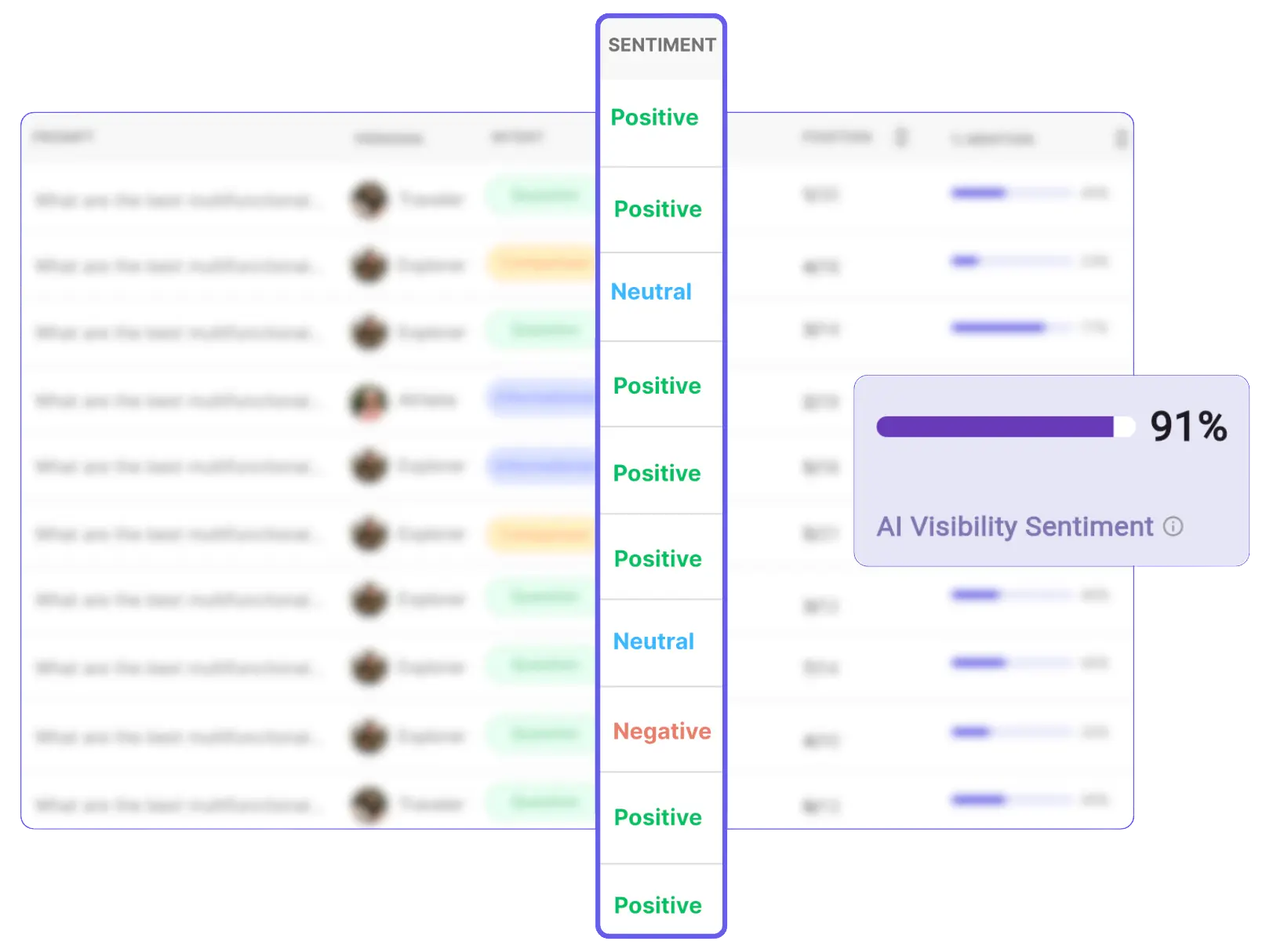
Sentiment Measurement analyzes how AI models describe your brand whenever it appears in a tracked answer.
At the account level, the AI Visibility Sentiment score shows the overall balance of positive and negative brand framing. At the prompt level, every result is labeled positive, neutral, or mixed. This helps you move from the overall score to the exact prompts, personas, and answers affecting it.
A growing mention count may look positive, even when AI describes your brand in a way that hurts consideration.
Your brand might appear in an answer but be framed as too expensive, less suitable, difficult to use, or weaker than a competitor for the persona’s needs. A neutral mention may provide little value, while a mixed answer may combine praise with objections that reduce the chance of being chosen.
These differences can also change between personas and AI models. One audience may receive a strong recommendation, while another sees your brand as a poor fit for the same general need.
Sentiment Measurement adds meaning to visibility data by showing not only whether your brand appears, but whether the way it appears helps or hurts perception.
Open the LLM Visibility Overview to see your account-wide AI Visibility Sentiment score.
The score summarizes how positively or negatively AI models describe your brand across tracked mentions. You can also see whether the score has increased or decreased compared with the previous period.
Review the sentiment column in your prompt monitoring table.
Each tracked prompt is labeled:
This makes it easy to find answers that need attention without opening every prompt individually.
Review which persona was assigned to each prompt and compare the answers generated across supported AI models.
The same brand may be framed positively for one audience but neutrally or negatively for another. Comparing these results helps you find the personas, needs, and models where brand perception is weaker.
Select any result and continue to AI Answer Analysis to read the complete response.
See the exact wording used to describe your brand, where it appeared in the answer, how it was compared with competitors, and which strengths or objections shaped the recommendation.
This helps explain why a prompt received a positive, neutral, or mixed classification.
Review the citations shown throughout the answer to see which sources support each paragraph.
Continue to LLM Citation Analysis to identify the domains and pages connected to weak or negative framing. These findings can help you decide which claims, content gaps, or external sources may need attention.
Track the prompt again over time to see whether the language and overall sentiment improve.

The score summarizes how positively or negatively AI assistants describe your brand across tracked mentions.
A score of 100 means all mentions are positive, 50 represents neutral sentiment, and 0 means all mentions are negative.
Positive means the answer presents the brand favorably. Neutral means the description is mainly factual and does not clearly support or criticize the brand.
Mixed means the answer includes both positive and negative framing, or presents strengths alongside meaningful limits or objections.
Yes. Every tracked prompt includes a sentiment label in the prompt monitoring table.
You can open the result to read the full answer and understand the language behind that classification.
A mixed result usually means the answer includes both favorable and unfavorable statements about your brand.
For example, AI may praise a product’s quality while describing it as expensive or unsuitable for the persona’s specific needs.
Yes. AI models may describe, compare, and recommend brands differently even when they receive the same prompt and persona context.
Use AI Answer Analysis to switch between models and compare the full responses.
Yes. Each persona brings different needs, priorities, preferences, and limits into the prompt.
A feature viewed positively by one persona may be irrelevant or negative for another, which can change how the model frames your brand.
Citations show which sources support the different paragraphs and claims in an AI answer.
By tracing weak or negative framing back to cited pages, you can identify the information and sources that may be shaping the model’s description.
Not always. AI may describe a brand positively without selecting it as the final recommendation.
Review the full answer to see whether the brand was recommended, compared, mentioned as an alternative, or simply described favorably.
Yes. The overview shows changes in the overall sentiment score, while repeated prompt monitoring lets you compare how individual answers develop over time.
This helps you see whether improvements in content, positioning, or external sources are followed by stronger brand framing.
Discover how your brand is perceived in AI.