
Simulate a multi-turn buyer journey with a selected LLM and see when your brand enters, rises, or drops from the consideration set.









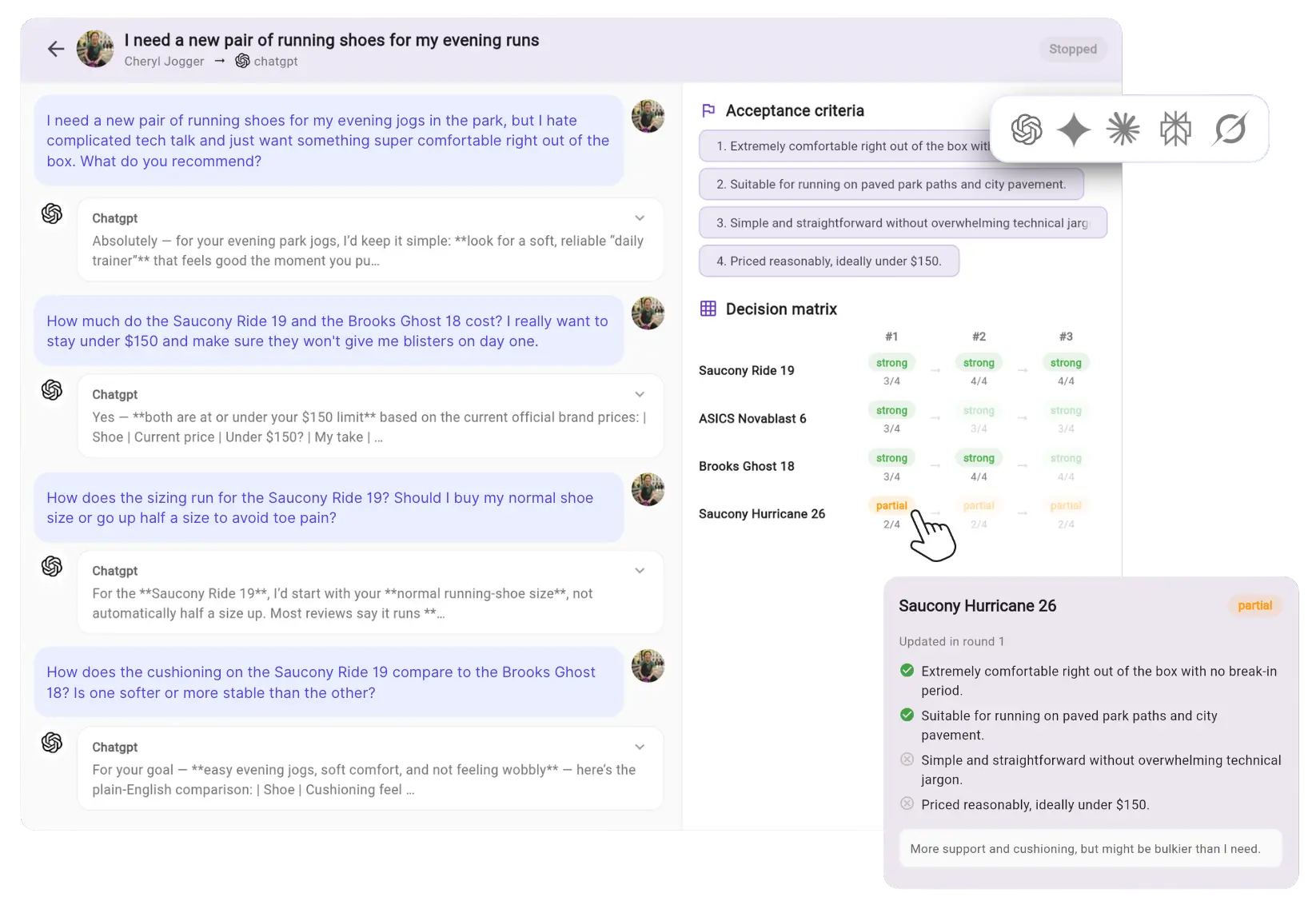
Chatoptic Buyer Simulation is a multi-turn research tool that reveals how an LLM guides a selected AI buyer persona from an initial need toward a product decision.
You define the goal of the journey, choose the relevant persona, and select the LLM you want to examine. As the conversation develops, Chatoptic tracks the criteria shaping the decision, which brands are recommended at each turn, how their positions change, and why a brand moves forward or drops out.
The simulation continues until you stop it, allowing you to follow the journey for as many turns as needed.
Most AI visibility tools measure isolated prompts. But real buying journeys do not end after one question.
People refine what they need, add new constraints, compare products, ask follow-up questions, and change their priorities as the conversation develops. Each new turn can change which brands the LLM recommends.
Your brand might appear when the request is broad, then lose its position when the buyer mentions price, compatibility, comfort, security, support, or another important requirement.
A visibility score can tell you whether your brand appeared. It cannot always tell you when the outcome changed or what caused it. Buyer Simulation reveals that turning point.
Start by describing what the AI buyer persona should try to achieve.
The goal could be choosing a product, comparing several providers, finding the best option for a specific need, or reaching a final recommendation under defined constraints.
Select the persona whose journey you want to follow, then choose the LLM on which the simulation will run.
This allows you to examine how the same category or decision may develop differently depending on who is asking and which AI model is answering.
The selected AI buyer persona continues the conversation with follow-up questions based on its needs, preferences, concerns, and previous answers.
The simulation keeps running until you decide to stop it.
Alongside the conversation, the Decision Matrix shows:
Click any brand status to see which criteria it meets, which ones it misses, and how that affected the recommendation.
Review the journey to identify:
Instead of seeing only the final recommendation, you can understand how the LLM arrived there.

An AI buyer simulation is a multi-turn conversation that examines how an LLM guides an AI buyer persona from an initial need toward a product or brand recommendation.
Chatoptic tracks the questions, decision criteria, recommended brands, and position changes that appear throughout the journey.
Regular AI visibility tracking usually measures the response to a defined prompt at a specific point in time.
Buyer Simulation follows an entire conversation. It reveals how recommendations change as the persona asks follow-up questions, introduces new requirements, and moves closer to a decision.
The Decision Matrix shows the criteria currently shaping the decision and how well each recommended brand meets them.
It also tracks how brand positions change throughout the conversation. You can click a status to see which needs a brand meets or misses and how that affects its recommendation.
An elimination point is the stage in the conversation where a brand loses its position or drops out of the consideration set.
Buyer Simulation connects that change to the new question, objection, constraint, or unmet criterion that caused it.
Yes. Before starting a simulation, you select the goal, the relevant AI buyer persona, and the LLM you want to examine.
You can run the same scenario with different personas or models to compare how the journey changes.
No. Buyer Simulation does not replace customer interviews, surveys, or behavioral research.
It examines how the selected LLM responds to a defined AI buyer persona and how that model shapes recommendations throughout a conversation. Its purpose is to help you understand the AI layer that now sits between many buyers and brands.
Not necessarily. Generative AI models may respond differently across separate runs, even when the starting conditions are similar.
Running comparable simulations more than once can help you distinguish a repeated pattern from a result that appeared in only one journey.
Discover how your brand is perceived in AI.